


Physical AI is a technology that enables robots and devices to capture real-world situations, make autonomous decisions, and act appropriately. In the industrial sector, it is already being utilized across a wide range of areas, from manufacturing to logistics, inspection, and construction. This article examines case studies of autonomous robot implementation, the evolution of robots that collaborate with humans, and the safety reliability mechanisms essential for social implementation, organizing the shift from automation to autonomy currently progressing in the industrial sector.
Physical AI Implementation Advancing in Manufacturing Logistics
Autonomous Robots Expanding in Smart Factories
In manufacturing , mechanisms for robots to operate autonomously while understanding their environment are becoming established. Particularly noteworthy are AMRs (Autonomous Mobile Robots) that handle transportation within factories. AMRs use sensors and AI to grasp their surroundings, autonomously selecting optimal routes while avoiding obstacles. Unlike conventional AGVs (Automated Guided Vehicles that travel along floor guides) which could only follow predetermined routes, AMRs can accommodate flexible layout changes and are highly effective in where production line changes are frequent.
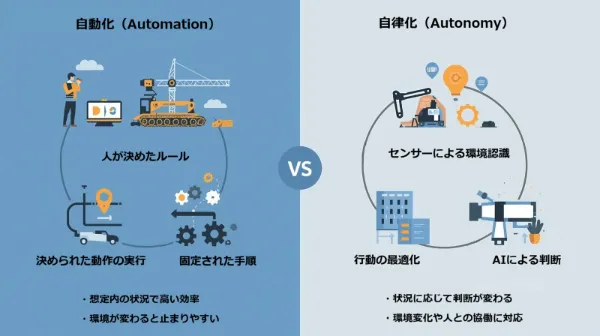
Additionally, by combining AI with robotic arms, tasks such as visual inspection and picking are becoming more sophisticated. Vision AI recognizes the position and orientation of parts, and based on this information, robotic arms adjust their movements in real time, transforming tasks that could previously only be performed with fixed sequences into autonomous work that adapts to variable environments. This also contributes to stabilizing processes that were difficult to handle without skilled workers, with implementation particularly advancing in areas facing serious labor shortages.
Advanced Autonomy in Logistics: Warehouse Robots Drones
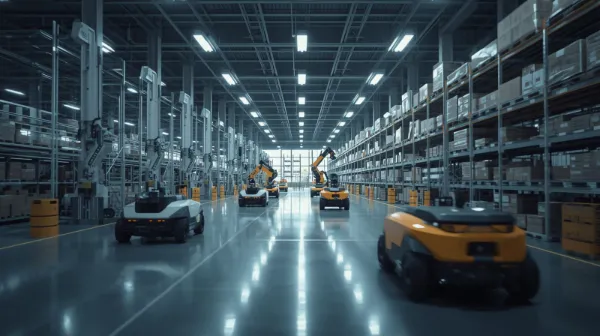
In logistics , the adoption of robots that move autonomously within warehouses is accelerating. Representative examples include systems that transport entire product shelves to workers (so-called GTP = Goods to Person) and systems where robots move to shelves and retrieve only necessary items. In Japan, companies such as Mujin and Rapyuta Robotics have advanced AMRs to the practical stage, enabling warehouse shelf arrangements and traffic flows to be revised according to circumstances, contributing to labor savings.
In where such warehouse robots operate, AI-based dynamic routing plays an important role. This refers to control that reconfigures movement routes in real time according to congestion and the presence of obstacles, enabling efficient and safe operation even in environments where multiple robots operate simultaneously.
Similarly, in logistics and inspection, initiatives utilizing drones are expanding. Indoors, they autonomously fly between inventory shelves to read barcodes and RFID (identification tags that read information contactlessly using radio waves), while outdoors they are used for infrastructure inspection and material delivery to mountainous areas, with applications rapidly expanding. As technologies supporting these applications, in addition to environmental perception using cameras and LiDAR (sensors that use laser light to accurately measure distance and shape to surroundings), verification through demonstrations and partial operational use is progressing for AI-based hazard prediction and route optimization. As a result, drones, which previously mainly followed predetermined flight routes, are now entering a stage of aiming for situation-based decision-making.
The autonomy of warehouse robots and drones is also positioned as a solution to worsening labor shortages. The ability to continue operating without stopping even in changing environments is a critical element directly linked to industrial competitiveness.
Evolution of Robots Collaborating with Humans
Rise of Cobots (Collaborative Robots)
In manufacturing and logistics , collaborative robots (cobots) that work in the same space as humans are beginning to play important roles. Conventional industrial robots were typically operated physically separated from humans by safety fences. However, cobots are designed to operate safely even when humans are nearby, through contact detection using force sensors and torque sensors, and motion estimation using AI.
Another feature is the significant reduction in programming effort. Direct teaching , where workers directly move the robot arm to teach it, has become widespread, making implementation easier even without specialized knowledge. In Japan, Daikin and Panasonic are advancing collaborative robot demonstrations for small and medium-sized factories, and the style of humans and robots working safely in the same space is gradually becoming established.
Regarding evacuation guidance that considers pedestrian flow data and congestion situations, demonstrations and research are also progressing, with expectations as a means to provide advanced support for decision-making and response during disasters. Currently, operations premised on human judgment are mainstream, but physical AI is an important element for enhancing the accuracy and responsiveness of disaster prevention measures.
Collaboration Advanced by AI
In recent years, robots have evolved beyond simply moving near humans to a stage where humans and robots understand each other's movements. For example, by using AI-based posture estimation technology, human work movements can be detected in real time, enabling the robot to adjust its speed according to those movements or retreat when necessary. Additionally, initiatives are expanding where AI learns skilled workers' task data and robots generate efficient work procedures, supporting the transfer of know-how.
While separating humans and robots was previously the premise for safety, we are now transitioning to an era where robots adapt to humans to achieve both safety and efficiency. This change indicates that physical AI is acquiring the ability to understand human intentions and actions.
Mechanisms Supporting Reliability Safety
Fail-Safe/Fail-Operational Design
The most important aspect in the social implementation of autonomous systems is ensuring safety. Particularly in situations where robots make autonomous decisions, what actions are taken in the event of a malfunction becomes critical.
Fail-safe is a design philosophy that stops operation to avoid danger to people or equipment when an abnormality occurs. On the other hand, fail-operational refers to design that can continue minimum operation even when some functions fail. The latter is required for autonomous mobile robots and drones, where sudden stops can be more dangerous. Multi-layered design is essential, including redundancy such as equipping multiple sensors with the same role to maintain situational awareness even if some fail, anomaly detection AI, and backup route planning.
AI Ethics Transparency
As robot autonomy increases, transparency of their decisions becomes important. Efforts to present AI decision rationale in an explainable form (Explainable AI) and ensuring unbiased data to guarantee fair operation are essential for establishing reliability. Additionally, for robots that may contact humans, clarification of responsibility and operational rules is required, as judgment errors can lead directly to danger.
Certification Systems Guideline Development
International standards for safety are being developed, such as ISO 10218 for industrial robots and ISO 3691-4 for autonomous mobile robots. Furthermore, AI governance policies are advancing in Europe and Japan, with discussions on data management methods and algorithm transparency. When companies transition from the demonstration stage to full-scale operation, compliance with such certification systems and guidelines becomes essential.
Summary
Physical AI is steadily advancing industrial from automation to autonomy . As robots that adapt to environmental changes, collaborate with humans, and continue to operate safely increase, applications are expanding across diverse areas including not only manufacturing logistics but also infrastructure inspection, construction, and healthcare. Going forward, autonomous systems where robotics and AI are inseparable will become an important foundation supporting industrial competitiveness.
References
[Introduction to Physical AI] Part 1: What is Physical AI — Overall Picture and Background of Its Emergence
[Introduction to Physical AI] Part 2: Sensing and Edge AI — The Eyes and Brain Supporting Physical AI
[Introduction to Physical AI] Part 4: Physical AI in Smart Cities — Toward Infrastructure that Senses and Moves the City
[Introduction to Physical AI] Part 5: The Future and Challenges of Physical AI — Ethics Safety Social Acceptance