

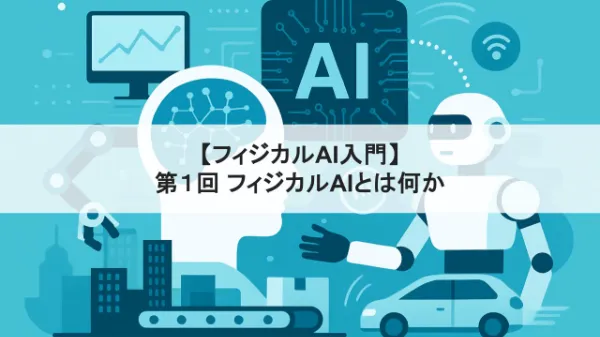
Physical AI, where AI autonomously makes decisions Sites and handles physical actions. At its core are sensing, which serves as the " eyes " that perceive the environment, and edge AI, which serves as the " brain " that makes on-site decisions. As these technologies advance, " intelligence " is beginning to emerge in various Sites such as buildings, factories, infrastructure, and mobility. The movement of AI stepping into the real world is accelerating. Through the evolution of sensing, robotics, and edge AI, " Physical AI ", where AI understands real space and autonomously makes decisions • and acts, is gaining attention as a new trend. This series will explain everything from its technological foundation to industrial applications, city-scale deployment, and future challenges over five installments. In Part 1, we provide an overview of the big picture and the background of its emergence. Here, we introduce the evolution of sensing and edge AI that support Physical AI, and the expansion of practical applications.
What is Physical AI — A New Domain Where Digital and Real Overlap
Until now, AI has developed significantly in fields dealing with data in digital space. On the other hand, systems that recognize reality through sensors and move physically, such as industrial robots, autonomous driving, and drones, have also existed. Currently, these movements are combining with more advanced AI technologies, and AI is expanding into a stage where it understands real environments, makes on-site decisions, and handles physical actions.
The term that has begun to be used primarily in industry • and business circles to refer to this new trend is " Physical AI ". While it is not yet an established technical term with an academic definition, it is treated as a concept representing the entire mechanism where AI connects with physical space and operates autonomously.
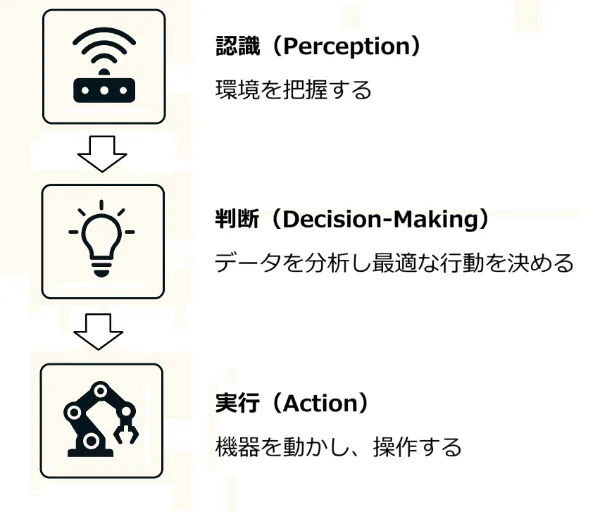
The characteristic of Physical AI lies in realizing a series of processes in the real world: " seeing, " " thinking, " and " acting ".
For example, Physical AI operates in the following flow:
Recognize surrounding conditions with cameras and sensors
↓
Determine optimal actions based on acquired information
↓
Connect to actual actions through robotics and control systems
Through this series of functions, digital and real are continuously connected, enabling advanced actions such as accurately grasping objects, moving autonomously, and switching operations in response to human instructions.
Why Physical AI Now — Social Issues Concentrated in Real Space
Interest in Physical AI has rapidly increased because many social issues occur in real physical space. In manufacturing, aging equipment and increased energy consumption are challenges, and in healthcare • and nursing care Sites, the burden of ensuring safety and monitoring is increasing. In logistics and retail, labor shortages are becoming serious, and efficient operations are required. In cities, many issues are intricately intertwined, such as aging infrastructure, disaster preparedness, traffic congestion, and responding to changes in pedestrian flow.
These issues cannot be solved by digital analysis alone. A mechanism is needed that grasps situations in real time, makes immediate decisions Sites, and takes necessary actions. In other words, realistic solutions become visible only when AI deeply penetrates the real world and has the ability to make decisions Sites.
Technologies Comprising Physical AI
Physical AI is not a single technology but is established through the collaboration of technologies from multiple domains. Here is an overview of the main technologies.
Sensing Technology: Foundation for Converting Physical Space into Data
Various sensors collect environmental information such as temperature, humidity, illuminance, noise, CO2, pedestrian flow, vibration, and water levels. In recent years, sensors have become smaller, • longer-lasting, • and lower-cost, enabling deployment in all kinds of locations such as factories, buildings, stores, and urban spaces.
Data obtained from sensors corresponds to the " eyes " of Physical AI. Only when data with sufficient accuracy and volume is available can AI properly assess Sites conditions.
Edge AI: Instantaneous Decision-Making Sites
While cloud AI excels at large-scale processing, communication delays become an issue in situations requiring real-time performance. Edge AI resolves this. By performing AI decision processing on devices located right next to equipment, quick autonomous decisions can be made according to the following situations:
• Anomaly detection → Immediate equipment shutdown
• Changes in pedestrian flow → Instant air conditioning adjustment
• Danger detection → Robot operation restriction
Robotics/Actuation: Reflecting AI Decisions into Actions
Robotics and actuation (drive) play the role of executing decisions derived by Physical AI as actual actions in the real world. Actuation refers to the concept of the function of " actuators (drive devices) " that move motors and mechanisms, and in Physical AI, it handles the final stage of materializing AI-determined content as physical actions.
For example, the following actions correspond to actuation:
• Adjusting machine output
• Controlling air conditioning to change temperature
• Moving a robot arm to grasp objects
These actions are realized when control systems mediate between AI decisions and actuator operations. Control systems convert the content of " what to move and how " decided by AI into signals that devices can understand, and transmit them to actuators safely and accurately.
In this way, through the collaboration of robotics, • actuation, • and control systems, Physical AI fulfills the role of " converting decisions into actions ".
Applications Expanding to Diverse Fields — Manufacturing, • Healthcare, • Cities
Physical AI is being implemented in various industries, and demonstrations are becoming active. Here is an overview.
Manufacturing: At the Core of Smart Factories
AI analyzes equipment operation data and vibration data to determine optimal operations. Areas where Physical AI creates added value are expanding, including anomaly prediction detection, energy-saving control, and autonomous transport.
Healthcare • and Nursing Care: Balancing Safety and Efficiency
AI analyzes pedestrian flow and vital information within facilities to reduce monitoring burden. The use of Physical AI is expanding, including surgical assistance by medical robots and in-hospital logistics robots.
Smart Cities: Optimization at Urban Scale
Cities that integrate urban data such as CO2, noise, traffic, pedestrian flow, and water levels, and operate with AI considering safety, • comfort, • and energy savings are increasing.

Social Impact and Future Issues
Physical AI has the potential to not only remain in industrial domains but also reconstruct social systems. Social benefits such as optimizing energy consumption, improving infrastructure maintenance efficiency, reducing environmental impact, and supporting labor are expected to grow even larger in the future.
However, Physical AI, where AI directly acts on the real world, also has the following challenges:
• Ensuring safety
• Responsibility in case of malfunction
• Privacy and ethical issues
• Role division between humans and AI
Going forward, discussions toward sustainable and safe social implementation will be important, considering both the potential and challenges of Physical AI.
Summary
Physical AI is a new approach that connects digital and real to optimize real space. We introduced its overview this time, and Physical AI may have become visible as a familiar technology.
In this series, we will further explore its technological elements, applications, and concrete visions of social implementation in the following four installments.
References
[Introduction to Physical AI] Part 2: Sensing and Edge AI — The " Eyes and Brain " Supporting Physical AI
[Introduction to Physical AI] Part 3: Industrial Applications of Physical AI — Robotics and Autonomous Systems
[Introduction to Physical AI] Part 4: Physical AI in Smart Cities — Infrastructure that " Senses and Moves " Cities
[Introduction to Physical AI] Part 5: The Future and Challenges of Physical AI — Ethics, • Safety, • Social Acceptance