

As global challenges such as climate change and environmental pollution become increasingly severe, the key to realizing a sustainable society lies in technologies that visualize invisible environmental information. From monitoring airwater qualityand soil to smart agriculture, sensing technologies serve as the foundation supporting the achievement of the SDGs (Sustainable Development Goals). This article explores how contributes to building a sustainable society through the latest trends in environmental monitoring and smart agriculture.
Sensing Technologies Supporting Environmental Monitoring and SDGs
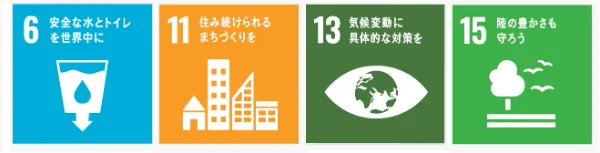
Among the SDGs, Goal 6 Clean Water and Sanitation, Goal 11 Sustainable Cities and Communities, Goal 13 Climate Action, and Goal 15 Life on Land are deeply connected to the visualization of environmental data. In practice, sensors continuously measure environmental data such as temperaturehumidity, CO2 concentration, river water quality, and soil composition, and by collectingand storing this data in the cloud through IoT, it has become possible to grasp environmental changes in real time.
Traditionally, environmental data was limited to fixed-point observations and sampling by specialized institutions. However, with the widespread adoption of sensing technologies, it has become a shared resource accessible to everyone, influencing not only policy formulation by governments but also citizen behavior and corporate environmental management. Sensing technology is becoming part of the social infrastructure supporting the realization of the SDGs.
Latest Trends in AirWater Qualityand Soil Monitoring
In the field of environmental monitoring, sensor miniaturizationincreased sensitivityand reduced power consumption have advanced remarkably, significantly improving observation range and accuracy. Let's examine the role of sensing technologies in the three major environmental elements: airwater qualityand soil.
Air Monitoring: Visualizing Urban Invisible Pollution
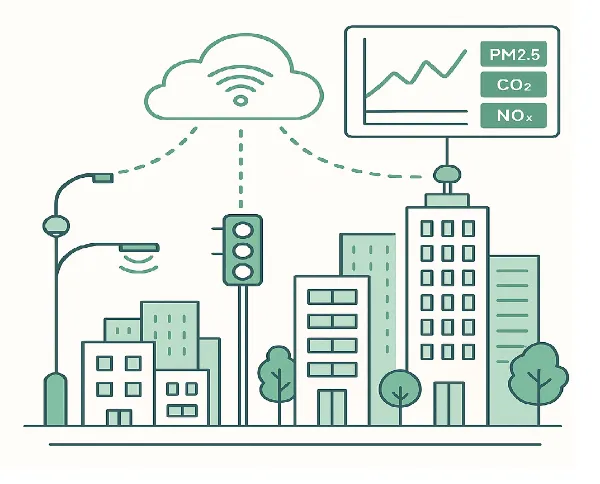
In urban air environments, systems for continuous monitoring of pollutants such as PM2.5, CO2, and nitrogen oxides are being established. By installing compact sensors on streetlights, traffic signals, and building rooftops and transmitting data to the cloud via wireless communication, air quality can be monitored in real time by area.
In recent years, cities worldwide, including Guangzhou, have been advancing the deployment of smart poles (smart multi-function poles), with increasing examples of integrating environmental sensors that measure PM2.5, CO2, temperature and humidity, and noise into streetlights and traffic signals. These devices are not merely observation equipment but are also utilized to solve urban challenges such as traffic management, dust suppression, and heat island countermeasures.
Water Quality Monitoring: Monitoring River and Reservoir Health
In the water quality field, multi-parameter water quality sensors that automatically measure pH, turbidity, conductivity, dissolved oxygen (DO), and other parameters are installed in rivers, lakes, and factory discharge outlets to continuously monitor environmental health. These sensors transmit data remotely using communication technologies such as LPWA and 5G, enabling real-time monitoring in the cloud.
In Japan, river water quality monitoring systems that continuously measure multiple parameters are being tested in projects related to the National Institute of Advanced Industrial Science and Technology (NEDO) and the Ministry of Economy, Trade and Industry. Results include improved inspection efficiency and faster anomaly detection, which are being utilized to establish systems that detect risks such as floods and chemical spills early and minimize damage.
Soil Monitoring: Foundation for Resource-Circular Agricultureand Environmental Conservation
In agricultural land and green areas, the introduction of soil sensors that measure soil moisture, salinity, and fertility in real time is advancing. This data is utilized to prevent excessive fertilization and irrigation while maintaining soil fertility and reducing environmental impact.
In recent years, local governments and research institutions have been advancing the collectionand analysis of regional soil data, which is used not only for maintaining agricultural land fertility and optimizing urban greening but also for managing landslide and sediment disaster risks. Particularly on slopes and embankments with high sediment disaster risk, continuous monitoring of rainfall and ground moisture using multifunctional soil moisture sensors has begun.
Sensing technologies cultivated in agriculture are now expanding their application to disaster prevention and infrastructure maintenance, and soil monitoring has become an important mechanism contributing to both regional safety and environmental conservation.
Common Trend: Distributed Sensors × Cloud Integration × Visualization
Common to these three fields is the fusion of distributed sensor observation and cloud-based integrated management. By aggregatingand analyzing data collected individually by sensors installed in various locations in the cloud and visualizing it on maps and dashboards, environmental conditions can be comprehensively understood.
Furthermore, systems where AI analyzes data trends and performs anomaly detection and predictive analysis are also being established. As sensor technology and data platforms become more integrated, environmental monitoring is evolving from mere observation to prediction and optimization. Such environmental monitoring data is applied to various fields including traffic regulation, planting plans, and architectural design, contributing to improved urban comfort.
Smart Agriculture Opening the Path to Sustainable Farming
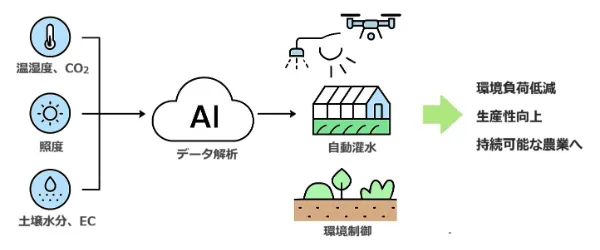
In the agricultural sector, smart agriculture initiatives utilizing data obtained from environmental monitoring are also expanding. Sensors acquire information such as temperature and humidity, CO2, illuminance, and soil moisture, and AI analyzes it to control growing environments in real time, becoming an important foundation supporting sustainable food production systems.
Private sector participation is also active, with Toyota Motor Corporation announcing at the 2025 Agriculture WEEK a soil sensor capable of real-time measurement of 21 parameters including pH, CEC (cation exchange capacity), nitrogen, and phosphoric acid. As a smart agriculture technology, it is recognized for preventing excessive fertilization and reducing environmental impact.
Systems combining sensing technology and digital control include automatic irrigation systems, weather data-linked greenhouse control, and drone-based visualization of growth conditions. Systems where AI automatically controls irrigation by analyzing soil moisture, EC (electrical conductivity), and temperature and humidity data are also becoming widespread, realizing new agricultural models that balance effective water resource utilization and improved productivity.
Foundation of Environmental : IoT Platforms Connecting Data
To utilize environmental data collected by sensors, mechanisms to connect and integrate them are essential. IoT platform development is advancing to enable centralized management of sensors installed in fields such as air, water quality, soil, and agriculture, and to shareand utilize data.
These platforms are designed to accommodate different communication standards and equipment manufacturers, and their highly scalable architecture enables integration of diverse sensors. Furthermore, AI performs data analysis in the cloud, and automation of monitoring and control is realized, such as issuing real-time alerts when thresholds are exceeded.
In recent years, local governments and companies are applying environmental data to disaster prevention and urban planning, also utilizing it to improve the resilience of entire smart cities. IoT platforms are now not merely a foundation for collecting data but are becoming the core of that transforms environmental data into social value.
Conclusion
Environmental monitoring through sensing technology has the power not only to measure nature but also to transform how society functions. By connecting data from air, water quality, soil, agriculture, and utilizing it with AI and IoT, new mechanisms are emerging that harmonize the environment and people. This flow of environmental is a solid step toward realizing a sustainable society. Understanding the environment through data and building a better future—sensing technology is at the center of this endeavor.