


Physical AI, where AI autonomously makes decisions in Sites and performs physical actions. At its core are sensing, the "eyes" that perceive the environment, and edge AI, the "brain" that makes on-site decisions. As these technologies advance, "intelligence" is beginning to emerge in various Sites such as buildings, factories, infrastructure, and mobility. Here, we introduce the evolution of sensing and edge AI that support physical AI, and the expanding practical applications.
Evolution and Diversification of Sensing Technology ― The "Eyes" that Capture Sites Reality
Sensing technology plays the role of acquiring Sites data that forms the foundation of physical AI. In recent years, diverse information such as temperature/humidity, CO2, human presence, illuminance, images, sound, vibration, and location data can be acquired with unprecedented accuracy and speed.
Sensors in particular have become smaller, • more sensitive, • and lower in power consumption with each model update, significantly improving installation flexibility. This makes it easier to deploy numerous sensors in buildings and factories, and configurations that cover wide areas while minimizing wiring work have become realistic.
Additionally, Sites conditions that were difficult to determine from a single sensor can now be more concretely understood by combining multiple information sources. For example, composite sensing enables deeper interpretation of what is happening in Sites as follows.
• Human presence + CO2 → Estimate occupancy and ventilation requirements
• Image + Vibration → Multifaceted detection of equipment anomaly signs
• Temperature/Humidity + Illuminance + Human movement → Balance comfort and energy savings
With this ability to understand Sites conditions more multidimensionally, sensors are beginning to play a role not just as measurement devices, but as a foundation supporting the quality of Sites decision-making and control.
Real-time Decision-making and Control with Edge AI ― The "Brain" that Thinks Instantly in Sites
Edge AI is essential for utilizing information obtained through sensing. As a mechanism that performs AI inference on the sensor or device side without sending to the cloud, it is particularly effective in domains requiring real-time performance.
"Instant thinking" completed in Sites without relying on the cloud
In domains requiring millisecond-level responses such as automatic door opening/closing, factory equipment anomaly detection, and drone obstacle avoidance, edge AI that can make decisions without being affected by network latency is effective. The ability to make local decisions independent of communication environment is a major advantage in Sites where stable operation is prioritized.
Proliferation of Low-power AI Chips and TinyML*
The technological foundation supporting edge AI has also changed significantly in recent years. In particular, the following low-power AI technologies are becoming widespread.
• Ultra-low-power AI accelerators
• TinyML* running on microcontrollers
• Event-driven sensors (operate only when needed)
By combining these, it has become possible to limit processing to necessary times and reduce power consumption during standby. These technological advances have increased examples of AI devices that can be used long-term even on battery power. While dependent on usage scenarios, situations where AI can be utilized even in power-constrained environments are expanding, making adoption a realistic option.
*TinyML (Tiny Machine Learning): Technology for running machine learning models on extremely low-power microcontrollers. Characterized by the ability to perform inference and anomaly detection on sensing data on the device alone without using the cloud.
Practical Examples and Advances in Power-saving Technology ― Expanding Applications in Smart Buildings • Factories • Infrastructure
The fusion of sensing and edge AI contributes to efficiency • and safety improvements in various Sites.
Smart Buildings: Operating HVAC • Lighting • Ventilation "Only as Needed"
In offices and commercial buildings, by integrating multiple sensors and analyzing with edge AI, the following operations become possible.
• Adjusting HVAC output according to occupancy
• Automatically determining necessary ventilation while suppressing over-ventilation
• Automatic lighting control according to solar radiation conditions
Such composite control is generally said to enable energy savings of around 10-30%. While actual results vary greatly depending on building conditions and operational circumstances, the ability to optimize energy use without compromising comfort is common across many Sites.
Factories: Predictive Maintenance Combining Vibration • Sound • Temperature
In factory equipment, vibration • sound • temperature and other factors are analyzed comprehensively to detect the following phenomena early.
• Minute vibration changes in bearings
• Gradual increase in motor load
• Irregular abnormal sound patterns
Since decisions can be completed on the edge side, they are not affected by network latency and contribute to reducing equipment downtime risk.
Logistics • Infrastructure: Demonstrating Capability in Domains Requiring Real-time Performance
Sensors + edge AI are also utilized in AGVs*, drones, smart intersections, and more. By combining diverse sensors, it has become possible to more accurately understand what is happening in the surroundings, leading to increased cases of improved safety and operational efficiency.
*AGV (Automated Guided Vehicle): Automated transport robot for carrying goods in factories and logistics warehouses.
Summary
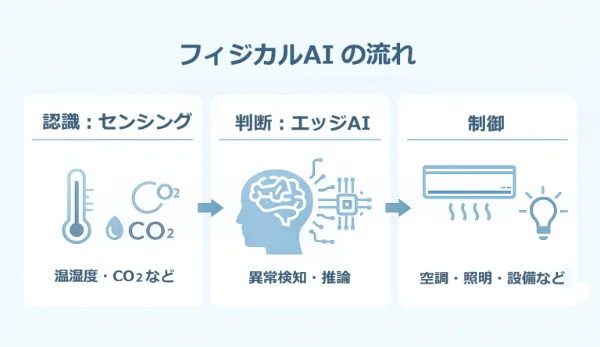
Physical AI is structured around the flow of "recognition • decision-making • execution", and sensing technology and edge AI are core elements supporting the first two "recognition • decision-making". By functioning reliably, systems can more accurately perceive the environment and make stable decisions. The information obtained through sensing and the role played by edge AI are becoming increasingly important in enhancing Sites convenience and reliability.
References
[Introduction to Physical AI] Part 1: What is Physical AI ― Overall Picture and Background of Its Emergence
[Introduction to Physical AI] Part 3: Industrial Applications of Physical AI ― Robotics and Autonomous Systems
[Introduction to Physical AI] Part 4: Physical AI in Smart Cities ― Toward Infrastructure that "Senses and Moves" the City
[Introduction to Physical AI] Part 5: The Future and Challenges of Physical AI ― Ethics • Safety • Social Acceptance