

In recent years, sensors and AI have been grasping physical space in real time, advancing the operation and decision-making of urban infrastructure. Supporting this mechanism is Physical AI, which is being considered for application • and implemented not only in industrial domains such as factories and warehouses, but also in urban infrastructure fields including transportation, energy, and disaster prevention. This article focuses on the convergence of urban OS and real-space control, and examines the role and potential of Physical AI in smart cities.
Convergence of Urban OS and Real-Space Control
In recent years, in the context of smart cities, the term " Urban OS " has been used as a mechanism to aggregate • and visualize data scattered throughout the city. Against the backdrop of advanced AI and the spread of CPS (Cyber-Physical System) architectures that link physical and digital spaces, some cities and projects are now seeing Urban OS play a central role in supporting real-space control.
Urban spaces contain diverse observation points such as traffic volume sensors, environmental sensors, and facility sensors. By having AI analyze this data in real time and reflect it in signal control, lighting control, air conditioning control, etc., Physical AI that operates in the flow of " recognition → decision → control " is being demonstrated • and implemented in smart signal control and building management.
Through such mechanisms, urban infrastructure is evolving from something operated in a fixed manner to a dynamic system that can adjust control policies according to circumstances. Similar to smart factories in manufacturing, the concept of " recognizing physical space and reflecting it in control " is beginning to spread in cities as well.
Specific Examples in Energy • and Disaster Prevention Fields
Energy Field: Smart Building Clusters and Area Optimization
In the energy field, initiatives incorporating the concept of Physical AI are advancing, centered on advanced cities and districts. In addition to energy conservation at the individual building level, cases of district EMS (Energy Management Systems) and campus EMS that optimize energy use across entire areas by treating multiple buildings collectively are also being reported.
The mechanism by which AI analyzes data obtained from sensors for electricity, temperature/humidity, human presence, etc. installed in each building, predicts demand peaks, and automatically adjusts air conditioning and lighting control is becoming a standard approach in smart buildings and ZEB (Net • Zero • Energy • Building) related buildings and campuses. Furthermore, in some demonstrations and advanced cases, attempts to distribute loads at the district level in coordination with demand response (*) during tight power supply-demand situations are also being observed.
*Demand response is a mechanism by which the demand side (companies and households) adjusts power consumption when electricity demand increases.
Additionally, efforts are advancing to enhance the sustainability of energy supply during disasters by combining with microgrids, storage batteries, EVs, etc. Physical AI is positioned as one of the technological elements that advances such energy control.
Disaster Prevention Field: Predictive Detection and Decision Support
In the disaster prevention field as well, Physical AI-like approaches utilizing sensors and AI are attracting attention. Mechanisms that continuously collect • and analyze data such as rainfall, water levels, and vibrations to identify signs of disaster risk early and support the issuance of alert information and response decisions are already progressing from the research • and demonstration stage to implementation at some local governments and infrastructure operators.
For example, when rapid water level rises are detected, initiatives are being considered to issue warnings while conducting evacuation guidance using lighting and digital signage. With such mechanisms, depending on the design, it becomes possible to link multiple controls.
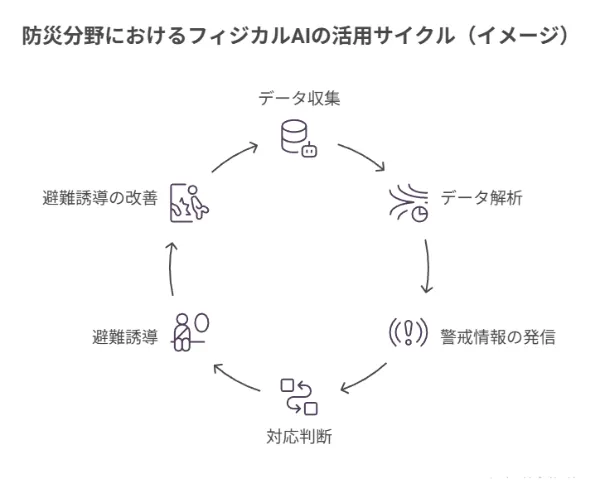
Evacuation guidance that considers pedestrian flow data and congestion conditions is also being demonstrated and researched, and is expected as a means to highly support decision-making and response during disasters. Currently, operations premised on human judgment are mainstream, but Physical AI is one of the important elements that enhances the accuracy and responsiveness of disaster prevention response.
The Role of Scalable IoT Platforms
To make Physical AI function in smart cities, highly scalable IoT platforms are essential. Cities contain a wide variety of sensors and facilities with different purposes and manufacturers, and if these are operated in a fragmented manner, control across the entire city becomes difficult.
A common infrastructure that integrates different data and enables unified visualization • and control is positioned as an ideal state in many smart city concepts. However, in reality, challenges remain not only technically but also in terms of governance, due to dependence on specific operators or products and differences in data standards.
Therefore, it is important to adopt a design that enables flexible coordination on the premise of future sensor additions and use case expansions. IoT platforms that can be utilized across fields such as energy, disaster prevention, and transportation can be said to be the foundation for continuously promoting Physical AI utilization in cities.
Summary
Through the coordination of Urban OS, sensors, AI, and scalable IoT platforms, the very way urban infrastructure is operated is being reconsidered, going beyond mere data utilization. The Physical AI approach that enables flexible control according to circumstances will continue to be examined to realize safer, more efficient, and sustainable urban infrastructure.
References
[Introduction to Physical AI] Part 1: What is Physical AI — Overall Picture and Background of Its Emergence
[Introduction to Physical AI] Part 2: Sensing and Edge AI — The " Eyes and Brain " Supporting Physical AI
[Introduction to Physical AI] Part 3: Industrial Applications of Physical AI — Robotics and Autonomous Systems
[Introduction to Physical AI] Part 5: The Future and Challenges of Physical AI — Ethics, • Safety, • and Social Acceptance