

For smart buildings •smart cities aiming for decarbonization and advanced urban functions, sensing technologies centered on sensors have become essential elements. Their application is advancing across diverse fields such as energy efficiency, comfort improvement, disaster prevention •safety measures, shaping new urban paradigms. This article organizes the main sensing technology applications and implementation examples in smart buildings •smart cities, and examines future prospects and challenges.
Smart Buildings: Sensing Applications Balancing Comfort and Energy Savings
In smart buildings, environmental sensors such as temperature/humidity sensors, CO2 sensors, and occupancy sensors play a central role.
Temperature/Humidity Sensors
Temperature/humidity sensors monitor indoor environmental changes in real-time and optimally control air conditioning in coordination with AI. By visualizing temperature variations with heat maps to refine air conditioning control, examples exist of achieving annual electricity cost reductions exceeding 6 million yen and CO2 emission reductions.
CO2 Sensors
CO2 sensors constantly monitor indoor air conditions and promote appropriate ventilation to help create comfortable environments. By automatically ventilating when a certain CO2 concentration is exceeded, they can maintain safety and comfort while preventing energy waste from excessive ventilation.
Occupancy Sensors
Occupancy sensors detect human presence/absence to automatically control lighting and air conditioning, preventing wasteful operation and simultaneously achieving energy savings and improved operational efficiency. In recent years, high-precision micro-motion detection sensors have emerged, enabling operations that reduce energy consumption without compromising comfort even in offices and meeting rooms with prolonged stationary work.
As an implementation example of such environmental sensors, advanced buildings like Grand Front Osaka have AI comprehensively analyze data from temperature/humidity •CO2 •occupancy sensors to achieve optimal lighting •air conditioning control.
Additionally, to maximize the effectiveness of sensing technologies, the presence of an IoT platform that can integrate various sensor information and provide unified control •monitoring is crucial. A system that can flexibly connect different sensor types and manufacturers while supporting real-time data analysis and optimal control underpins the sustainability and operational efficiency of smart buildings.
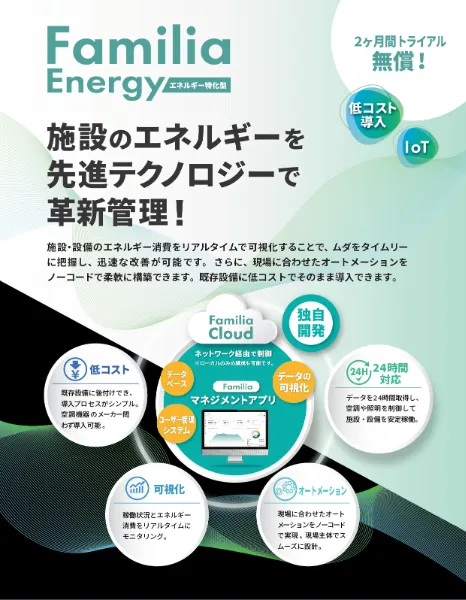
Haudi provides an energy management platform "Familia Energy" utilizing cutting-edge technologies such as IoT, AI, and cloud. It visualizes electricity consumption and temperature/humidity data collected by IoT sensors and automatically controls equipment to prevent energy waste throughout the building. By using IoT sensors and wireless adapters, construction work during installation can be minimized, offering the advantage of reduced implementation costs.
Smart Cities: Achieving Safety •Comfort •Efficiency Across the Entire City
In smart cities, monitoring •management of entire areas beyond individual buildings is required. Here too, various sensors play important roles.
Noise Sensors
Noise sensors are installed near high-traffic roads and industrial areas, with AI automatically detecting abnormal noise. In Uruma City, Okinawa, this system is utilized to detect dangerous driving such as drift racing, with demonstrations conducted for enhanced enforcement and deterrence.
Water Level Sensors
Water level sensors are installed in rivers and sewers, with AI predicting flood risks in advance by combining rainfall •weather data. This enables rapid dissemination of evacuation information to residents and road closure decisions, enhancing municipalities' disaster response capabilities.
Vibration Sensors
Vibration sensors are installed on bridges and high-rise buildings to continuously monitor vibrations from earthquakes and large vehicle passages. When abnormal values are detected, administrators are immediately notified, contributing to minimizing earthquake damage and preventive maintenance of aging infrastructure.
Data obtained from these sensors is increasingly reflected in real-time in various urban operations through AI analysis. It is utilized for traffic signal control, traffic flow optimization, disaster evacuation guidance, and enables advanced predictive control.
In Hangzhou •China, the "ET City Brain" combining over 4,000 cameras •sensors achieves automatic traffic signal control through AI real-time analysis, early detection of accidents •congestion, priority passage for emergency vehicles, and safety monitoring. Domestically, multiple cities have begun initiatives to integrate and manage pedestrian flow •weather •traffic •infrastructure data, linking with urban OS and digital twins. This is expected to improve overall urban efficiency and resilience.
Prospects and Challenges of Sensing Technologies: Toward Sustainable Cities
For smart buildings and smart cities to develop further, next-generation technologies such as energy harvesting and edge AI are essential. These complement the shortcomings of existing sensing technologies while enabling further advancement of urban spaces.
Energy Harvesting
Energy harvesting is a technology that obtains minute amounts of electricity from sunlight, vibration, temperature differences, etc. to power sensors. Since wiring and batteries become unnecessary, sensor installation flexibility and maintenance ease improve dramatically. This enables deployment in locations where installation was previously difficult, such as underground, on bridges, and at heights.
Edge AI
Edge AI is a technology that immediately analyzes •controls sensor data Sites without sending it to the cloud, achieving real-time response without delay and reducing communication load. It detects •determines abnormal vibrations, water leaks, rapid temperature/humidity changes, etc. on-site and notifies only necessary actions, streamlining citywide management.
On the other hand, as smart buildings and smart cities expand, challenges to be addressed have also emerged. Examples include standardization of data coordination between different sensors and systems, cybersecurity measures to prevent unauthorized access and information leaks, applicability to existing buildings and aging infrastructure, and visualization of cost-effectiveness.
The key to solving these issues is flexible IoT platforms, and approaches from both technological and human perspectives are expected, combined with operational know-how and personnel development Sites.
Summary
Sensing technologies are the central foundation that significantly improves energy efficiency, comfort, disaster resilience, etc. in smart buildings and smart cities. As various sensors evolve by integrating with IoT •AI technologies, the operation of cities and buildings is becoming smarter and more flexible. Moving forward, while incorporating advanced technologies, progress will continue in creating smart and sustainable urban and building environments.