


We are hearing the term " smart city " more and more frequently. Smart city initiatives are currently being promoted nationwide, and the movement to leverage cutting-edge technologies such as ICT (information and communication technology) in urban development is becoming increasingly active. Here, we will first clarify what smart cities are, then introduce advanced examples from around the world that are one step ahead. We also touch on the current situation in Japan.
What is a Smart City?
The " Smart City Guidebook " jointly compiled by the Cabinet Office, • Ministry of Internal Affairs and Communications, • Ministry of Economy, Trade and Industry, • and Ministry of Land, Infrastructure, Transport and Tourism in April 2021 defines a smart city as " a sustainable city or region that solves various issues facing cities and regions and continues to create new value through the provision of services tailored to each citizen utilizing new technologies such as ICT and various public and private data, as well as through the advancement of management (planning, development, administration, • operation, etc.) in various fields, and is a place for the pioneering realization of Society 5.0 ".
To put it more simply, it could be said to be cities or regions that use cutting-edge technologies such as ICT and AI to streamline • and enhance urban and regional functions and services, solve various issues, and aim to improve convenience • and comfort for residents and businesses.
In smart cities, data is collected by deploying sensors and cameras throughout the region, integrated and analyzed by AI. By remotely controlling equipment • and devices as needed, infrastructure, • facilities, • and operational tasks are optimized. Specifically, solutions are expected for issues such as energy management, public safety, monitoring of elderly and children, traffic congestion relief, and disaster preparedness.
The scope of smart cities is not limited to urban areas but includes initiatives in regions with satoyama and satoumi. Regional development in harmony with abundant nature, " smart local ", is also one form of smart city. It is hoped that smart city initiatives will advance in various regions by incorporating cutting-edge technologies such as ICT into urban development.
Smart City Initiatives Advancing Worldwide
Smart city initiatives began in Europe in the 2000s. Over the subsequent 20 years, they have spread to various parts of the world and are producing results in forms suited to the characteristics of each region. Let's look at examples of smart cities in cities around the world.
Barcelona, Spain •
Barcelona's smart city transformation began in 2000. Now, more than 20 years since the initiative started, many social infrastructures are connected to an integrated system called " Sentilo ", contributing to administrative efficiency and improved citizen services.
Sensors and cameras are installed throughout the city, and all collected data is centrally managed by " Sentilo ". Each department of the city hall and related contractors refer to " Sentilo " information to respond, and many public services have been automated, advancing efficiency.
Specific smart city measures are as follows:
- Parking spaces on streets are managed by parking sensors installed on roads. Parking status is aggregated in " Sentilo " and citizens can check via apps. Parking violation checks by staff are no longer necessary.
- Traffic enforcement on major roads is automated with permanent speed sensors and cameras.
- Through linkage of speed sensors and traffic lights, when driving exceeding the speed limit is detected, the next signal turns red.
- Sensors are installed in all trash bins to prioritize collection of full bins.
- Sprinklers and fountains in parks and street trees are automatically controlled by sensors that detect temperature and humidity.
- Street light operating hours and brightness are optimized based on brightness and pedestrian traffic detected by sensors, with public safety information factored in.
What is particularly outstanding is the adoption of " NaviLens ", a service for the visually impaired, centered on the city's public transportation such as subways and buses. " NaviLens " is a service originating in Spain developed to support independent walking for visually impaired people, consisting of tags (square patterns similar to QR codes) embedded with information and an app that reads them.
Tags are embedded with information such as the current location situation and surrounding information, and are used by posting them on walls and pillars inside facilities. When you launch the app on a smartphone and hold it up in the air, the app catches the tag and announces the embedded information by voice. As you walk while holding your smartphone up in the air, it continuously reads out necessary information by voice, making it a groundbreaking service that facilitates movement to destinations.
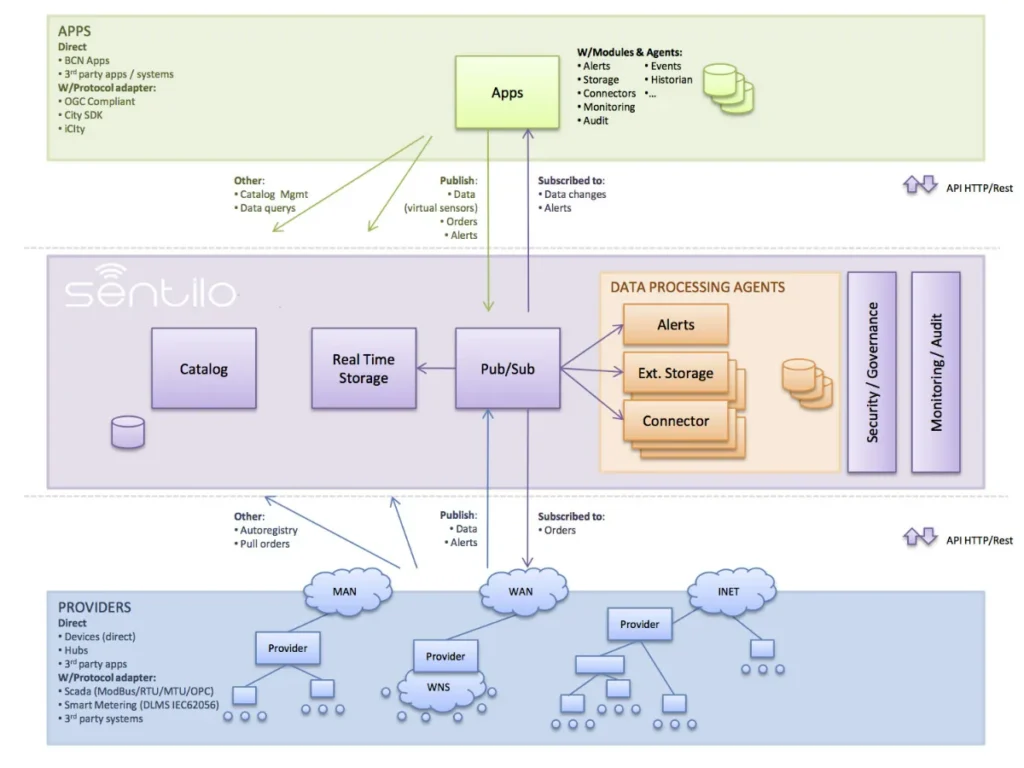
Sentilo Configuration Diagram (Sentilo Homepagequoted from)
Singapore
Singapore ranks first for three consecutive years in the global smart city ranking " IMD Smart City Index ". It is undoubtedly a smart city leader. In 2014, it announced the " Smart Nation " initiative and has been aiming to become a smart nation. It has focused on five particularly important areas: urban living, transportation, health, e-government, and corporate • business support, advancing smart city projects nationwide.
One of Singapore's characteristics is its focus on digitizing administrative services. Taking birth registration as an example, it is possible to submit notifications from mobile devices and receive child birth bonuses from the government as part of a continuous process. There is no need to visit government offices, and with the convenience of completing everything with just a smartphone, citizens can naturally benefit from the smart city system.
Also, the project to digitally twin the entire nation, " Virtual • Singapore ", became a major topic as a world-first initiative. This involves converting everything that exists in the country—terrain, buildings and structures, transportation, etc.—into 3D data and reproducing a realistic city in virtual space (digital twinning), with real-time data on the location of people and vehicles added. Simulations that are difficult in physical space are easy in " Virtual • Singapore " and are being utilized for new policies and urban development.
Virtual • Singapore (GeospatialSG Homepagequoted from)
Hangzhou, China •
In China, smart city initiatives began at the national level in the late 2000s. Among them, Hangzhou has achieved results in smart city transformation by adopting " City Brain ", a cloud-based digital platform developed primarily by Alibaba, which is headquartered in the city.
Hangzhou had serious traffic problems such as congestion, but now AI analyzes live camera footage in real time and switches traffic lights to alleviate congestion. An automatic notification system to police in case of accidents has also been established.
Smart city technology has also been applied to COVID-19 infection control measures. The app " Health Code " developed by Alibaba displays health status in three levels by cross-referencing with big data held by the government. It serves as a so-called digital health certificate. Public transportation such as subways and buses, as well as accommodation and commercial facilities, require presenting the app's QR code to a reader to use, playing a major role in infection prevention.
Japan's Current Situation
Looking at Japan's smart city situation, it is clear that it lags behind the world, with Tokyo ranking 84th and Osaka 86th in the smart city ranking " IMD Smart City Index 2021 ", showing poor performance. Despite having high-level technology, it has not yet contributed to people's convenience and comfort in daily life.
The government is strongly promoting smart city transformation, and signs of acceleration toward smart city realization through public-private collaboration are emerging. Various scales of development are underway, including " Kashiwa-no-ha Smart City " in Kashiwa City, Chiba Prefecture, with Mitsui Fudosan and others as joint operators; " Smart City Takeshiba ", utilizing cutting-edge technology throughout the Takeshiba district in Minato Ward, Tokyo, through collaborative urban development by SoftBank and Tokyu Land Corporation; and " Woven City " under construction by Toyota Motor Corporation in Susono City, Shizuoka Prefecture.
Regional movements are also noteworthy. In 2021, the government launched the " Digital Garden City Nation Initiative ", beginning efforts to promote digital implementation from rural areas to revitalize regions. According to the plan, progress will be made starting from areas where digital effects can be felt, tailored to each region's circumstances. This policy overlaps significantly with smart cities • and smart local initiatives, and future developments are anticipated.
Summary
The trend toward smart city transformation, incorporating cutting-edge technologies such as ICT into urban development, is likely to advance in Japan with government support. While there is a sense of falling far behind the world, we should promote smart transformation tailored to each region while referring to pioneering examples from other countries.