

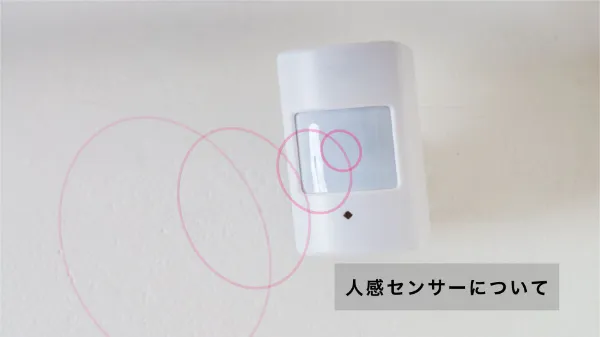
Do you know how automatic doors that are familiar in our daily lives, or toilet lights that turn on and off automatically, are operated? This article focuses on motion sensors that react to human movement and control the operation of devices, and provides a detailed explanation.
What are motion sensors ?
As the suggests,sensors that detect and respond to human movementis the general term. When a person approaches this sensor, the switch of the device linked to the motion sensor automatically turns on, or conversely, when a person moves away, the switch turns off. They are widely used in places with high foot traffic such as toilets, entrances, and changing rooms.
The most commonly used motion sensor around us would be the pyroelectric infrared sensor. In fact, the human body constantly emits thermal energy called infrared rays that are invisible to the human eye. Pyroelectric infrared sensors detect this weak thermal energy emitted from the human body and send electrical signals externally. This type is often used for automatic doors and automatic lighting control because it has a wide detection range and is inexpensive.
Besides the pyroelectric infrared type, there are various types such as sound sensors that react to sound and ultrasonic sensors that measure the distance to objects, and it is necessary to use them appropriately depending on the location and purpose. In any case, detecting human movement is very important, helping our lives by preventing forgetting to turn off lights and saving electricity, and enabling crime prevention measures with cameras that start recording when unauthorized entry into the premises is detected.
There are various installation methods for motion sensors. Motion sensors used for automatic door opening/closing and automatic lighting control are often integrated with the ceiling of the building or the device being controlled. Recently, standalone motion sensors compatible with wireless communication such as Bluetooth and Wi-Fi have also appeared, which can be retrofitted to facilities.
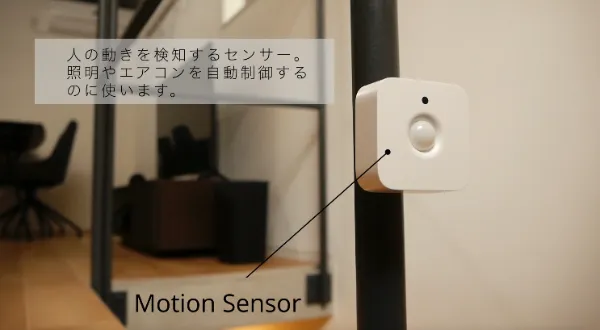
How motion sensors work
They detect changes in ambient air temperature, temperature differences, sounds, etc., and activate devices such as lighting.Generally, there are master units (elapsed time after a person leaves; turns off if no detection within set time; can only be used in limited areas) and slave units (cannot be used alone; work with master unit to expand detection range).
Detection range
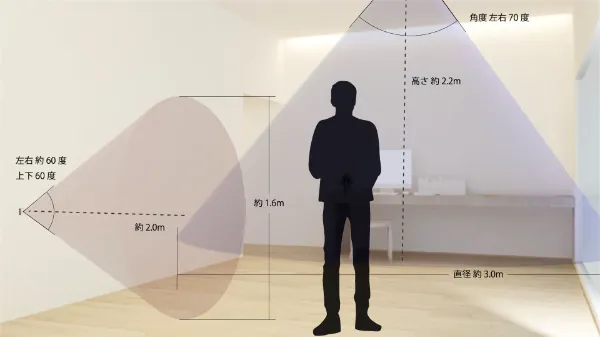
Motion sensors include ceiling-mounted types and wall-mounted types. Each has a different detection range.
Ceiling Distance: Height approx. 2.2m, Diameter approx. 3m / Angle: Left-right approx. 70°
Widely used in facilities and stores.
Wall Distance: Width approx. 2m, Height approx. 1.6m / Angle: Left-right approx. 60°, Up-down 60°
Widely used in residential spaces such as private homes.
Since a single motion sensor cannot cover the detection range for an entire facility, master and slave units are linked to expand the detection range.
Benefits of introducing motion sensors
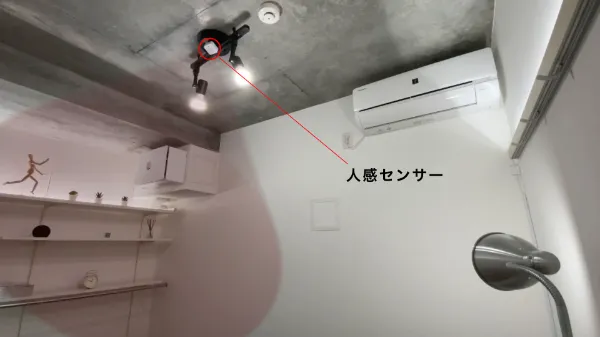
Achieving comfortable living
When returning home at night or entering an empty room, the hassle of searching for a switch is eliminated with automatic lighting. When leaving, it detects human movement and turns off automatically, so there's no worry about forgetting to turn it off. Automatic doors are very convenient when your hands are full.
Even with switches installed out of reach of small children, sensors can detect people and turn on the lights.
Also leads to energy savings
Automatically turns off air conditioning and lighting in unoccupied rooms, sounnecessary electricity costs can be reduced.
For air conditioning, it can flexibly respond to room temperature that varies with the number of people, andsettings to suppress long-term operationcan also be configured.
Security is also assured
By installing motion sensors at the entrance, lights can be illuminated when someone enters the premises, or security cameras can be activated. By installing them in places that tend to be blind spots such as entrances, near windows, and roadside areas with little foot traffic,the risk of intrusion can be reduced.
Reducing infection risk
By using motion sensors for lighting switches in buildings where many unspecified people come and go, such as commercial facilities, offices, and schools,operation without touching switches becomes possible, which also contributes to infection control measures.
Additionally, optimal air exchange can be easily performed, such as changing the strength of ventilation fans according to the number of people in the room.
How to utilize motion sensors
We introduce what can actually be done by usage scenario.
Residential
By using motion sensors, you can prevent forgetting to turn off lighting and air conditioning equipment. You can also adjust air conditioning according to the number of people in the room. In home care scenarios, it is possible to set up a system that sends notifications when there is activity at night.
Office
Data detecting when people gather through motion sensors helps distribute break times and create people flow. From conference room usage rates, expansion of the office can be considered, or conversely, if there are many vacant rooms, fixed costs can be reduced by downsizing the office.
※ Smart offices that incorporate motion sensors are also explained in this article."Optimizing the work environment with smart offices"
Care facilities
By installing motion sensors in hallways, falls of residents in unlit hallways at night can be prevented. Additionally, by introducing a system that notifies the management room of motion sensor information in real time, it becomes possible to notify the elapsed time spent in the toilet.
※ Care using motion sensors in care facilities is also explained in this article."Care has advanced this far! The latest technology is changing care "
Education
By turning off lights in empty classrooms, significant reduction in electricity costs becomes possible. For security, alerts can be issued when outsiders' entry into the premises is detected.
Summary
Motion sensors are already installed in many places, such as toilet lighting in commercial facilities, automatic operation of escalators, and automatic adjustment of air conditioning.
Motion sensors can be installed later in existing buildings. Since there are products that combine light bulbs and motion sensors, turning on and off can be done automatically simply by installing the bulb.
Additionally, since it is possible to memorize and human movement, when movement from the first floor to the second floor is detected, the lighting on the second floor can be turned on, enabling movement that matches the resident's behavior, making life more convenient.
In the future, won't they spread not only to commercial facilities but also to many residences?