


Aiming for fundamental transformation through the use of digital technology (Digital Transformation). This is rapidly spreading in the logistics industry, which faces increasing burdens and mounting challenges. Here, we will focus specifically on logistics warehouses and explain the background, content, and latest technologies used for .
Current State and Challenges of the Logistics Industry
With the changing times, the situation in the logistics industry has become increasingly severe. Let's look at the current state of the logistics industry as the background for why is urgently needed in logistics warehouses.
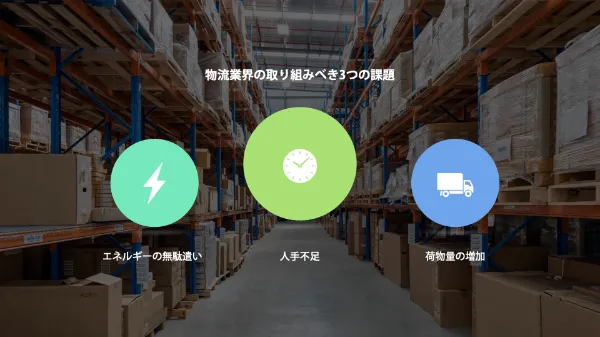
Increased Burden Due to Growth in Small-Lot Deliveries
Due to the impact of the COVID-19 pandemic, users of online shopping and peer-to-peer transactions such as Mercari and Yahoo Auctions have surged. As a result, small-lot deliveries of small amounts and low values have increased. In addition to the burden from the quantitative increase, small-lot deliveries also increase the effort required for sorting work, creating a situation where the burden on increases from two aspects.
Furthermore, the increase in small-lot deliveries has reduced transportation efficiency, leading to rising logistics costs. The impact of increased small-lot deliveries affects not only the burden on but also logistics costs significantly, making it an urgent issue that must be resolved.
Worsening Labor Shortage
As logistics demand increases, the logistics industry suffers from chronic labor shortages. While the declining birthrate and aging population are major factors, the reality is that people are also avoiding the industry due to the demanding nature of logistics work. Since new young hires are not keeping pace with the number of departures, both labor shortages and workforce aging are accelerating simultaneously.
As a result of labor shortages, the workload per worker increases and the burden becomes heavier. Long working hours are also a major problem, and measures to resolve labor shortages are an urgent situation that cannot wait.
Energy Issues
Due to their nature, logistics warehouses often operate 24/7, keeping lighting and air conditioning on at all times. As a result, the overall energy consumption of the warehouse increases, putting pressure on utility cost billing to tenants.
What is in Logistics Warehouses?
Digitalization is advancing in various fields, utilizing the latest digital technologies such as IoT and AI to streamline operations. Logistics warehouses are no exception.
IoT (Internet of Things) is called the Internet of Things and refers to technology that enables various objects to connect to the internet for more convenient use. Using this technology, you can operate home appliances from a smartphone or monitor the current temperature and humidity of a room remotely.
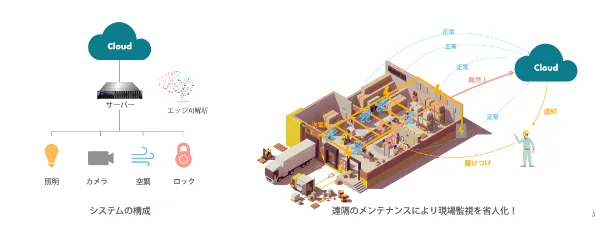
Many management tasks performed in logistics warehouses, such as inventory management, temperature management, management, and materials management, can be streamlined through digitalization. Common specific measures include the installation of IoT cameras and sensors and the introduction of management systems. IoT devices connected to the internet manage the warehouse status via the network.
As labor-saving and automation of operations advance, paths to improvement open up for labor shortage and logistics cost issues as well. Effects such as preventing human errors and enhancing logistics security can also be expected, enabling advancement of toward fundamental transformation.
Digital Technologies Used in Logistics Warehouse
Let's look specifically at the latest IoT devices and systems used in various processes of logistics warehouses.
Main IoT Devices
IoT Temperature Management Sensors
These are utilized in food warehouses and other facilities requiring temperature management. Even from remote offices or branch locations, temperatures at multiple locations within the warehouse can be confirmed on management system screens.
IoT Cameras
Installation of network-connected cameras enables low-cost warehouse management and monitoring.
Devices Using IoT Weight Sensors Smart Mats
Simply by placing products on the smart mat, measured remaining quantities are automatically aggregated as inventory data. This streamlines inventory work. Accurate inventory management is possible remotely, and ordering can also be done.
Vehicle Detection Sensors
Installation of vehicle detection sensors enables monitoring of truck presence at warehouse loading docks and issuing entry instructions to trucks, even from remote locations.
Others
Sensor types include motion sensors and temperature/humidity sensors. Picking robots that automatically pick up products are also becoming increasingly adopted.
Management Systems
Various management systems tailored to specific purposes are being developed and provided to efficiently perform various operations via networks using IoT devices such as cameras and sensors.
The content is wide-ranging, including systems that enable inventory management and inbound/outbound confirmation on the cloud, systems that integrate and manage various IoT sensors, ordering systems, and systems that monitor the warehouse work environment based on temperature and humidity sensor data, supporting logistics warehouse operations.
Furthermore, as management systems evolve and collaboration between tenants, delivery companies, and warehouse management companies becomes possible, they will develop into more advanced solutions such as collection route optimization. For example, if the logistics volume within the warehouse and the cargo volume in trucks can be grasped to some extent, collection can be optimized using the cloud.
Summary
To solve the many problems facing logistics warehouses, streamlining operations using digital technology is now an urgent priority. We should proceed wisely with the introduction of IoT devices and management systems according to the needs of each facility.