

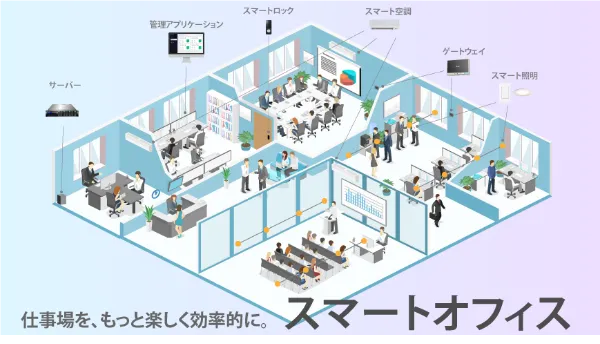
In recent years, new forms of "homes" utilizing IoT and AI, such as smart homes, have become widespread, making our lives more comfortable and convenient. This time, we will introduce "smart offices", which create a more productive work environment in "offices" rather than "homes".
A smart office refers to a state-of-the-art office that introduces digital technologies such as IoT and AI to automatically control air conditioning, lighting, and other systems within the office to optimal conditions. Additionally, IoT sensors connected via network to various equipment in the building automatically collect and • analyze all data within the office, automatically controlling air conditioning systems and lighting equipment. While smart office adoption is not yet widespread domestically, it is steadily expanding overseas, and many companies are expected to adopt it domestically in the future.
IoT (Internet of Things) is called the "Internet of Things" and refers to technology that makes things more convenient by connecting various objects to the internet. Using this technology, you can operate home appliances from your smartphone or monitor your room's current temperature and humidity remotely.
Benefits of Smart Office Implementation "Improved Productivity"
The greatest benefit of implementing a smart office is "improved productivity". So why does productivity improve?
Improved Productivity
Productivity represents how much output is achieved relative to the time and resources invested in work. The most important factor in improving productivity is said to be a "comfortable work environment", showing how crucial the workplace is. Additionally, companies that continuously work on improving their work environment are said to be "highly productive companies".
Work in Your Preferred Space
Online access to vacant seat and room information allows smooth usage status • and reservation management, making it possible to provide work environments tailored to employee needs, such as free address seating (working at any preferred seat without a fixed desk in the office) or focus booths. Recently, with the introduction of remote work and staggered commuting, being able to see at a glance who is in the office when and where is also an advantage.
Additionally, with automatic control of air conditioning and lighting, optimal conditions can be maintained at all times regardless of time or weather.
Reduced Employee Stress
Being able to choose where to work means coming to the office is no longer mandatory. Not riding crowded trains reduces mental stress. This promotes physical and mental health, further leading to improved motivation and willingness to contribute to work.
Furthermore, wearable sensors can analyze employee health and psychological states, alerting managers to critical information and preventing illnesses caused by overwork.
Review and Optimization of Operations
Using network cameras commonly employed in IoT, you can observe not only headquarters but also employees working at distant branches. Based on recorded footage, you can compare work styles between headquarters and employees, and remotely review operational improvements and attendance management.
For example, ordering supplies is an important task, but the process from checking inventory to placing orders takes surprisingly long. By incorporating data such as when to order based on inventory levels or ordering more during specific periods, continuous ordering tasks can be automated, making time usage more efficient. Additionally, by automating not just supply ordering but also simple tasks, you can eliminate waste in daily operations and spend time on your core work.
All of these factors combined lead to comprehensive "improved productivity".
Enhanced Office Security
Using biometric authentication such as facial recognition systems and retinal scans also strengthens security. There's no need to carry employee IDs or card keys, eliminating the risk of loss.
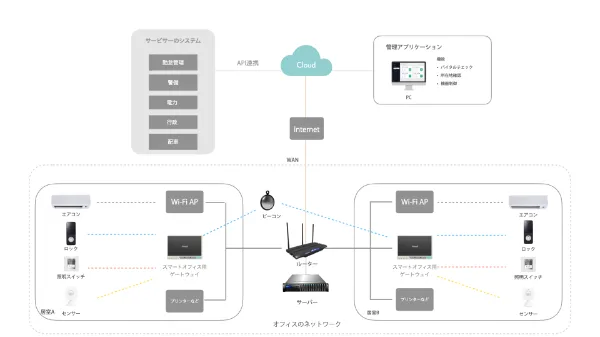
Smart offices benefit not only users but also providers who want to "reduce fixed office costs" or "improve operational efficiency while avoiding excessive operation". This is achieved by reducing traditional office space through remote environment setup and monitoring employee working hours and psychological states in real time. Additionally, issues like "leaving lights on" or "leaving air conditioning on" can be addressed through smart office implementation by automatically turning off lights and air conditioning when people leave, leading to cost reduction.
Summary
We hope you understand that smart offices are highly attractive, offering benefits to both users and providers. However, making all office equipment smart at once may require enormous costs and time for employees to adapt. How about gradually implementing smart features, starting with just lighting, just air conditioning, or just the entry system?