

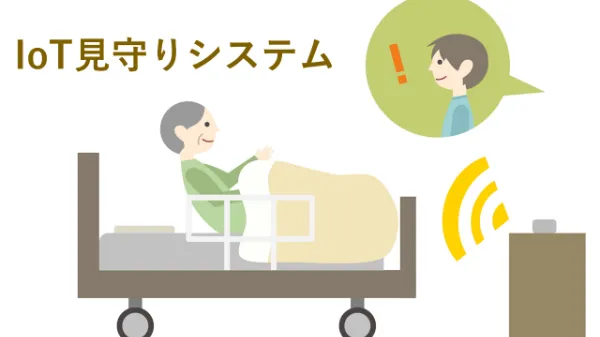
Monitoring systems incorporating IoT technology are attracting attention. As labor shortages become increasingly severe, demand is growing mainly in the nursing care field, and they are also expected to be a promising solution for monitoring family members living apart. We will introduce what devices are being used, where, and how, while also touching on issues.
What is an IoT Monitoring System
An IoT monitoring system is a system that uses digital technologies such as IoT and AI to remotely monitor the safety and health status of elderly people and others. Large-scale systems are centered mainly in the medical and nursing care fields, but implementation is also progressing in homes of elderly people living alone and other places where monitoring is needed.
In nursing care facilities, various sensors detect the condition of residents and the environment inside their rooms, displaying information in real-time on computers, smartphones, and tablets of staff in other rooms or distant locations. When abnormalities or signs are detected, alerts are issued, allowing staff to respond accordingly. This system can be said to improve the quality of monitoring while reducing the number of rounds and room visits, thereby reducing staff burden. The function of automatically recording data detected by sensors also promises improved operational efficiency.
Since IoT monitoring systems can monitor remotely, they are very effective for watching over elderly family members living apart, such as parents living alone. Many services are already being deployed and attracting attention that utilize IoT devices and IoT home appliances, including sensors and cameras, allowing the safety of elderly people to be confirmed anytime on smartphones and other devices. The same applies when monitoring elderly people receiving home care, and there are also devices useful for preventing and locating wandering.
Types of Sensors
In IoT monitoring systems, the following IoT devices, centered on sensors, are being used.

Motion Sensor
A non-contact sensor that reacts to temperature and heat, detecting human movement and passage. In rooms, it not only identifies presence but also detects conditions such as posture on the bed and getting out of bed.
Vital Sensor
A sensor that detects vital data such as body movement, heart rate, and respiration of the subject. Vital sensors used in monitoring systems are mainly non-contact types installed under bed mattresses, which detect vital data and also function as bed-exit sensors described later. There are also types installed on ceilings or walls.
Bed-Exit Sensor
A sensor mainly for detecting conditions on the bed, such as sitting up, protruding from the bed, and getting out of bed. Types include sheet sensors in the form of mattress pads, sensor beds with sensors built into the bed itself, and load sensors installed on bed legs. Mat sensors placed at the foot of the bed detect when the subject puts their feet down from the bed to the floor. All are used to help prevent falls and tumbling accidents.
Temperature and Humidity Sensor
Measures room temperature and humidity with sensors and controls them automatically. Since many elderly people dislike air conditioning, this is particularly effective in preventing heatstroke during summer.
Open/Close Sensor (Door Sensor)
Installed on doors of rooms, toilets, etc., and sliding windows to detect opening and closing. In addition to preventing accidents and wandering within facilities, for monitoring family members living apart, safety can be confirmed by installing open/close sensors on daily routes such as toilets.
Network Camera
Installed in rooms, hallways, etc., and used for monitoring and tracking behavior such as wandering. When abnormalities are detected by various sensors, if they can be confirmed through camera footage, it can be immediately determined whether it is necessary to rush to the scene, so there are benefits to using them in combination with sensors.
Beacon
A beacon is a small device that transmits Bluetooth signals. It works in conjunction with a receiver and is used to track the location of subjects. By detecting when subjects walk alone or go out and issuing alerts, it can be used to prevent wandering and for searches.
Issues with IoT Monitoring Systems
Let's also understand the issues related to IoT monitoring systems. This is knowledge that should be known to maximize the benefits of implementation.
Initial Costs and Implementation Preparation Required
System implementation requires initial costs according to scale. Since many systems assume a stable internet Wi-Fi environment, facilities may also incur costs to establish Wi-Fi infrastructure. Preparation for implementation may also be necessary, such as creating manuals for system use, study sessions, and operation practice.
Risk of Information Leakage
As long as it uses the internet, measures against security risks are essential. The risk of unauthorized operations and information leakage due to cyberattacks is not zero.
Regarding Privacy Considerations and Physical Restraint Prohibition Regulations
Regarding camera monitoring, subjects may feel resistance from a privacy perspective or feel stressed as if they are being surveilled. While there are devices that convert images to silhouettes, caution is needed in their use.
Also, be aware that even for monitoring aimed at peace of mind and safety, careless use of various sensors may constitute physical restraint . Physical restraint prohibition regulations state that in providing services, physical restraint and other acts that restrict the behavior of residents (users) shall not be performed except in cases of emergency and unavoidable necessity to protect the life or body of the resident (user) or other residents (users) . Carefully consider the installation of sensors as well.
Summary
In the trend of incorporating IoT technology across all fields, IoT monitoring systems particularly match social needs, and implementation is expected to advance further in the future. We should thoroughly understand the characteristics of sensors used in systems and adopt them wisely.