

DX (Digital Transformation) has become a widely used term in recent years, but questions are still heard such as " what is the difference from digitization " and " how are IoT and AI related ". Because there are many similar terms, some people may find it difficult to grasp the meaning and role of each. This article provides a simple explanation of basic terms commonly used in DX Sites from the perspective of " differences ".
■ Overall Picture of DX Terminology
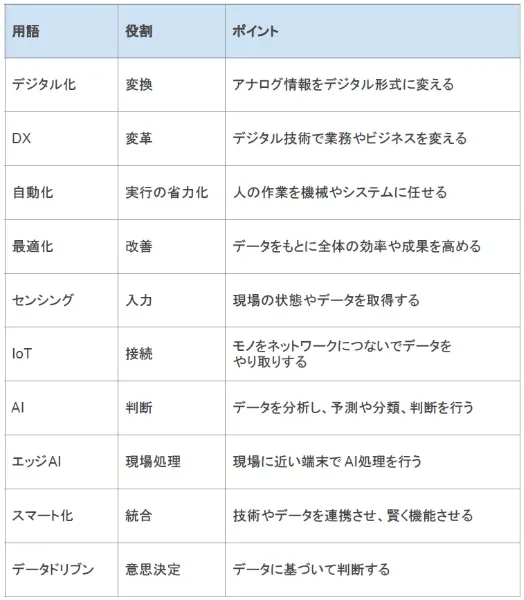
To grasp the overall picture of terminology related to DX, let's first organize the main terms along with their roles.
Difference Between " Digitization " and " DX "
Digitization refers to replacing analog operations that were done on paper or manually with digital means. In contrast, DX is an initiative that uses digital technology to transform the way work is done and the nature of business itself, creating new value. In other words, while digitization is " replacing the means ", DX can be understood as " transforming operations and value ".
For example, digitizing paper forms is digitization, but analyzing that data to review business processes or create new services is DX. Understanding this difference makes it easier to grasp that " IT implementation ≠ DX ".
Difference Between " Automation " and " Optimization "
Automation is replacing work that people did with machines or systems. Optimization is an initiative to adjust based on data and analysis to further improve overall efficiency and results. Automation focuses on " replacing tasks ", while optimization emphasizes " achieving better results ". Both are useful for business improvement, but optimization can be said to be a concept that comes after automation.
Simply automating equipment on • off remains automation, but if you adjust to the most efficient operating conditions based on operational status and environmental data, that is optimization. Understanding this difference clarifies that there are stages in the approach to business improvement.
Difference Between " Sensing " and " IoT "
Sensing is acquiring the state of Sites using sensors, such as temperature, humidity, and human movement. IoT is a mechanism that connects that data via networks and accumulates • utilizes it. In other words, sensing can be understood as " knowing the state ", while IoT is " connecting and leveraging ".
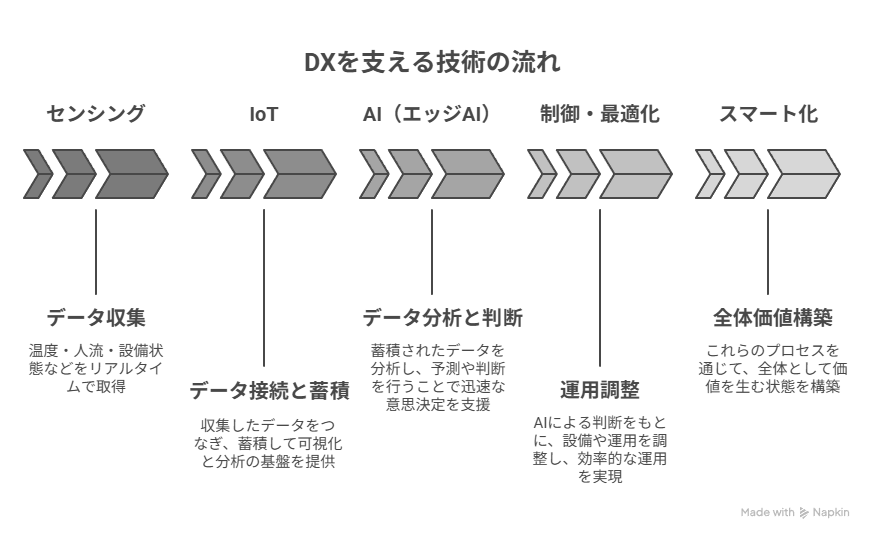
Simply measuring room temperature with a temperature sensor remains sensing. When that data is aggregated in the cloud and made available for remote monitoring and analysis, it expands to IoT utilization. Connecting data acquired through sensing with IoT, having AI make decisions, and controlling equipment—each technology plays a role in this series of processes.
Difference Between " AI " and " Edge AI "
AI refers to the technology itself that performs analysis and prediction based on large amounts of data and supports decision-making. Edge AI, on the other hand, is a mechanism that executes AI on the device side at the edge of the network, that is, in a location close to Sites. The difference between the two lies not in " functionality " but in " where processing is performed ".
AI can operate in the cloud or at the edge and can be used selectively according to applications and requirements. For example, cloud AI is suitable for advanced analysis using large amounts of data, while edge AI is effective when real-time performance is required, such as for detecting abnormalities in factory equipment.
By utilizing edge AI, benefits such as reduced communication latency, reduced network load, and improved security (data is not sent externally) can be obtained. In this way, AI and edge AI are not opposing concepts but are utilized while sharing roles within the overall system.
Difference Between " Digitization ", • " Smartification ", • and " DX "
Digitization, smartification, and DX are all related concepts, but each has a different role and position.
Digitization is an initiative to replace analog operations with digital ones. Smartification refers to a state where elements such as sensors, networks, data analysis, and control work together, functioning more sophisticatedly as an overall system. And DX is the concept of using these technologies to transform the nature of operations and business itself and create new value.
To summarize, digitization can be positioned as " replacing the means ", smartification as " integration and sophistication of technology ", and DX as " transformation of operations and value ".
For example, a system that automatically controls building air conditioning and lighting based on temperature, humidity, and foot traffic data is an example of smartification. Linking individual technologies to achieve more efficient and value-added operations can be called smartification. By reviewing operational methods and services through such initiatives, new value is created, leading to the realization of DX.
What is " Data-Driven "
Data-driven is the concept of making decisions based on data rather than relying on experience or intuition. What is important here is " making decisions based on evidence " rather than " vaguely ".
Even in equipment operation, more rational decisions become possible by analyzing operational data and environmental data rather than relying only on past experience. As data is visualized and utilized, the effects of business improvement and DX become greater.
Summary
Many technical terms are used in the Sites of DX, but organizing the differences and roles of each makes the overall picture easier to see. Understanding terminology is the starting point for advancing DX. It is important to deepen understanding of more specific initiatives and challenges based on the content organized in this article.