

DX (Digital Transformation) is advancing in the modern era, and sensing technology has become a critical foundational technology for digitalizing information from the physical world and utilizing it across various fields. This article explains the types and roles of sensors that support DX, as well as their integration with IoT, AI, and the cloud.
What Are Sensors?
Sensors are devices that detect quantities of physical, chemical, or biological properties and convert them into electrical signals. They play a role in detecting diverse environmental information such as temperature, humidity, vibration, current, light, and pressure.
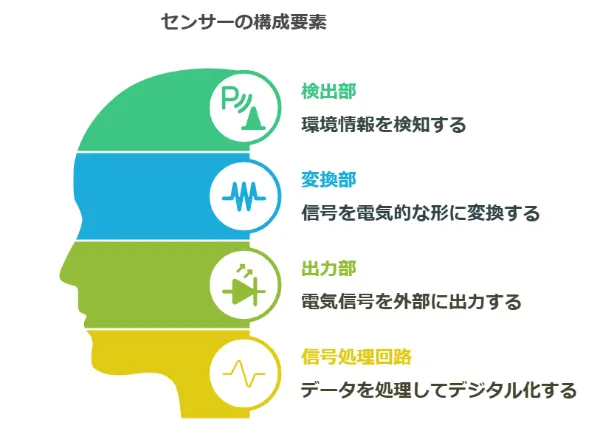
A typical sensor consists of the following three elements:
Detection unit (sensing unit): Directly detects environmental information
Conversion unit: Converts detected environmental information into electrical signals
Output unit: Outputs electrical signals externally
Additionally, sensors that include signal processing circuits may output digital signals. Operating principles vary depending on the type of sensor.
The Role of Sensors in DX
Various sensors play the following roles in DX:
- Real-time Data Collection: Sensors operate continuously, monitoring the status of equipment and environments in real time. They can instantly detect abnormalities and changes, enabling rapid and accurate decision-making.
- Objective Situation Assessment: Rather than relying on experience or intuition, objective decisions based on data become possible.
- Prediction and Optimization: By analyzing collected data, future predictions and optimal control become possible.
- Enhanced Traceability: Recording and visualizing product production processes and quality data improves quality management. Traceability is strengthened, making cause identification and problem resolution smoother when abnormalities occur.
Major Types of Sensors
Temperature and Humidity Sensors
Temperature and humidity sensors can simultaneously measure temperature and humidity, detecting ambient environmental conditions in real time. This enables proper air conditioning management and environmental optimization of manufacturing processes.
〈Operating Principle〉
Temperature sensors use thermistors or platinum resistance elements, measuring temperature by utilizing resistance changes due to temperature. Humidity sensors include expansion/contraction, wet/dry bulb, and electronic types (electrical resistance and capacitance types), detecting and measuring changes in physical properties due to water vapor content in the air.
〈Main Applications〉
Air conditioning control in smart buildings, environmental management of manufacturing processes, quality control of food and pharmaceuticals, environmental monitoring of data centers
Vibration Sensors
Vibration sensors detect vibrations, shocks, and their changes applied to structures and equipment, enabling early detection of abnormalities and failures. They are indispensable in manufacturing and infrastructure maintenance.
〈Operating Principle〉
Types of vibration include linear vibration, bending vibration, and torsional vibration. Vibration sensors use internal weights and springs that move in response to such vibrations, converting that movement into electrical signals through electricity-generating materials. They detect vibration characteristics such as displacement, velocity, acceleration, and frequency.
〈Main Applications〉
Preventive maintenance of manufacturing equipment, earthquake detection systems, structural health monitoring, collision detection in automobiles
Current Sensors
Current sensors measure current in electrical circuits and are used for monitoring power consumption and detecting abnormalities in electrical equipment.
〈Operating Principle〉
There are mainly magnetic field detection and resistance detection types. Magnetic field detection types convert the magnetic field caused by current into voltage using the Hall effect. Resistance detection types calculate current values by measuring voltage drop across shunt resistors.
〈Main Applications〉
Energy management systems, power consumption optimization, smart grid operation, fault diagnosis of electrical equipment
RFID Sensors
RFID sensors are technology that uses electromagnetic waves to read tag information contactlessly. They are widely used in logistics, inventory management, and security fields, with familiar examples including transportation IC cards (such as Suica and PASMO).
〈Operating Principle〉
When electromagnetic waves are sent from an RFID reader/writer to a tag, the IC chip in the tag activates, processes the stored information, and returns it. Passive tags use electromagnetic waves from the reader/writer as a power source and reflect those waves to return information. Active tags have built-in batteries, offering longer communication distances and enabling periodic information transmission and responses to commands from reader/writers.
〈Main Applications〉
Logistics management, inventory management, security systems, production line traceability
CO2 Sensors
CO2 sensors measure carbon dioxide concentration in the air and are used for air conditioning management and environmental monitoring.
〈Operating Principle〉
Non-dispersive infrared (NDIR) method measures concentration by utilizing CO2's property of absorbing infrared light at specific wavelengths. Chemical sensor methods measure concentration by utilizing changes in electrical properties due to oxidation-reduction reactions.
〈Main Applications〉
Indoor air quality management, automatic control of ventilation systems, greenhouse gas monitoring, industrial process control
Image Sensors
Image sensors convert light into electrical signals to capture images and video, and by processing the output images, they are utilized in autonomous driving, surveillance cameras, quality control, and more.
〈Operating Principle〉
Using CMOS or CCD technology, photodetector elements record light intensity and color, outputting them as image data.
〈Main Applications〉
Quality control and inspection in manufacturing, environmental recognition in autonomous vehicles and robotics, surveillance and facial recognition in security systems, diagnostic support in medical fields
Pressure Sensors
Pressure sensors measure the pressure of gases or liquids, contributing to safety management and process control.
〈Operating Principle〉
Pressure sensors mainly include piezoresistive and capacitive types. Piezoresistive types utilize changes in resistance due to pressure, while capacitive types utilize changes in capacitance due to pressure.
〈Main Applications〉
Pressure monitoring in pipes and vessels, prevention of equipment troubles and explosion accidents, real-time system control, compliance with regulatory standards
Gas Sensors
Gas sensors detect specific gases and are utilized in environmental management and safety measures.
〈Operating Principle〉
Using metal oxide semiconductors. Utilizing the principle that the resistance of the semiconductor changes due to oxidation-reduction reactions with gas, the presence and concentration of gas are detected by measuring this change in resistance.
〈Main Applications〉
Industrial process monitoring and control, workplace safety improvement (detection of toxic gas leaks), environmental monitoring and sustainability improvement
Acceleration Sensors
Acceleration sensors measure the motion and vibration of objects and are used in the control of machinery and vehicles.
〈Operating Principle〉
They sense the displacement of weights due to acceleration using piezoelectric elements or capacitive elements, converting them into electrical signals to measure acceleration.
〈Main Applications〉
Predictive maintenance of industrial machinery, motion control of robots and automation systems, safety systems in the automotive industry (such as airbag deployment)
Flow Sensors
Flow sensors measure the flow of liquids or gases, contributing to the optimization of industrial processes.
〈Operating Principle〉
They detect physical changes due to fluid flow. There are many methods including differential pressure, vortex, and electromagnetic types. For example, differential pressure types calculate flow rate by measuring the pressure difference due to changes in flow path cross-sectional area.
〈Main Applications〉
Process control and optimization, quality control, energy efficiency improvement, equipment protection
Integration with IoT • AI • and Cloud
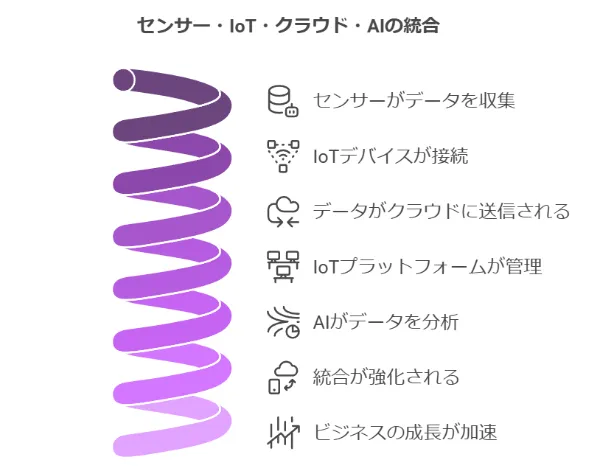
The integration of sensor technology with IoT • AI • and cloud is a key to industrial DX. This integration enables real-time data collection • analysis • and automated decision-making, promoting various innovations such as industrial process efficiency, preventive maintenance, and resource optimization.
Data Collection and IoT Integration
Sensors convert physical world data into digital signals and connect to networks through IoT devices. For example, temperature and humidity sensors transmit data to the cloud via Wi-Fi-enabled microcontroller boards or gateways. In this process, protocols such as APIs and MQTT are utilized to efficiently process large amounts of data. IoT platforms provide functions such as device connection management, data storage • and analysis, and security enhancement, supporting effective data utilization.
Integration with Cloud Platforms
The integration of cloud platforms and IoT is key to industrial DX. By utilizing lightweight and reliable MQTT protocols and APIs, IoT devices and cloud services can be efficiently connected. This integration realizes real-time analysis, data management efficiency through automatic backups, improved coordination between different systems and devices, enhanced security, and ensured scalability.
Through cloud and IoT integration, for example in manufacturing, equipment from different vendors can be monitored • and controlled in an integrated manner, advancing optimization of entire production lines. In agriculture, irrigation systems and environmental sensors can be utilized to enable crop management responsive to seasonal variations.
Data Analysis and Prediction by AI
Data analysis and prediction by AI is a method for effectively utilizing large amounts of data collected from IoT devices. Using machine learning algorithms, patterns and trends are identified from data, and more accurate prediction models are built. For example, in manufacturing, machine operation data is analyzed to predict failures and realize preventive maintenance. It is also utilized for demand forecasting and optimization, contributing to improved production efficiency and inventory management.
Security and Authentication
Security in IoT systems is a critical issue. Many platforms implement user authentication functions and encrypted communications to ensure data security.
Summary
Sensing technology has become an indispensable element in promoting DX. Through the utilization of various sensors, real-time data collection and optimization of equipment • and environments become possible, advancing the construction of more efficient and sustainable systems. Furthermore, through integration with IoT • AI • and cloud, advanced data analysis and prediction are realized, accelerating innovation in various domains including industrial fields. Going forward, it is important to continue monitoring the latest trends in sensing technology while expanding the possibilities of data utilization.