


DX As the importance of (Digital Transformation) is widely recognized, we often hear about challenges such as " initiatives failing to take root " and " not leading to desired results ". The causes of such stagnation often lie not in the technology itself, but in "barriers" that tend to be overlooked before implementation. This article examines the background of why DX stalls at Sites based on challenges occurring in Sites, and considers them from the perspective of " three barriers " that should be considered before technology.
DX does not progress through " technology implementation " alone
While the term DX has become widespread, its meaning is often understood in the context of " IT tool implementation " or " system renewal ". However, true DX means reviewing business processes and organizational structures, and transforming the very methods of value creation through data utilization.
Simply implementing new technology does not lead to changes in Sites. If conventional work and decision-making structures remain unchanged, new initiatives will not function properly, resulting in situations such as " implemented but not used " or " tried but not sustained ". In other words, DX cannot function adequately if existing structures remain unchanged.
So what barriers exist in the background?
Three barriers that stop progress at Sites
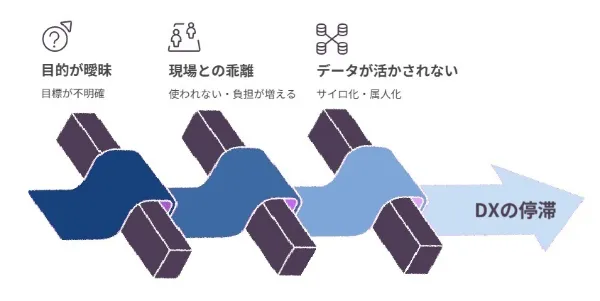
First barrier: Starting with ambiguous objectives
In cases where DX initiatives do not progress well, they often begin without sufficiently clarifying the purpose of " why we are doing this ". Advancing DX itself becomes the goal, and efforts tend to fall into a situation where they merely proceed without leading to results.
While initiatives may start based on reasons such as " we need to advance DX " or " competitors are also working on it ", if it is not clear which specific operations should be improved and what results are being targeted, evaluation criteria cannot be established. As a result, the so-called PoC stagnation, where only PoCs (Proof of Concept) are repeated without reaching full implementation, tends to become normalized.
Without clear definitions of objectives and results, DX remains merely experimental and does not lead to sustained results.
Second barrier: Disconnect from Sites
The next major obstacle is the gap in perception with Sites. Even when new systems or tools are implemented, if they do not align with Sites workflows and actual conditions, they are perceived as merely increasing burden. Particularly when the background and purpose of implementation are not sufficiently shared, " why we need to use this " is not understood, becoming a factor preventing adoption.
DX cannot succeed without Sites cooperation. Initiatives that proceed without incorporating Sites perspectives are more likely to stall at the actual operation stage.
Third barrier: Data not being utilized
In recent years, data collection has advanced at many companies, but it is not necessarily being fully utilized for decision-making or operational improvement. When data is fragmented by department or when analysis and utilization processes are not established, even acquired information does not translate into value. Additionally, when data interpretation and utilization depend on specific personnel, organizational utilization does not expand.
Data has no meaning merely by being accumulated; it creates value only when utilized. Such challenges are commonly seen across many Sites, and there is a need to reconsider approaches to data utilization. Simply collecting data does not lead to DX results.
Why do these barriers arise?
A common background to these barriers is that DX is not merely technology implementation but transformation involving the entire organization. DX is an initiative oriented toward overall optimization, not departmental optimization. However, in actual organizations, different goals and evaluation metrics are often set for each department, and cross-functional collaboration is frequently difficult.
Furthermore, if decision-making processes and evaluation systems remain conventional, incentives to support new initiatives do not work effectively. As a result, changes at the Sites level do not progress, and DX can become formalized.
Perspectives for advancing DX
So what perspectives are needed to overcome these barriers? One is to start with small initiatives and accumulate concrete results. Rather than trying to change everything at once, it is important to proceed steadily from a feasible scope. By setting clear objectives and evaluation metrics and visualizing success cases, deployment across the organization becomes easier.
Additionally, design based on understanding Sites operations is essential. Building structures aligned with actual operations and clarifying benefits for Sites is key to adoption. Furthermore, it is important to view data collection through utilization as an integrated whole. DX effects emerge only when structures are built that integrate data acquired through sensors and IoT, connecting visualization • analysis • control.
Summary
The background of why DX stalls at Sites lies not in the technology itself, but in structural challenges such as " ambiguous objectives ", " disconnect from Sites ", and " insufficient data utilization ". To overcome these barriers, a perspective that reviews company operations and organizational structures prior to technology implementation is essential. First, it is important to visualize where these barriers exist within your company. The first step in advancing DX is not implementing new tools, but correctly recognizing these barriers.