

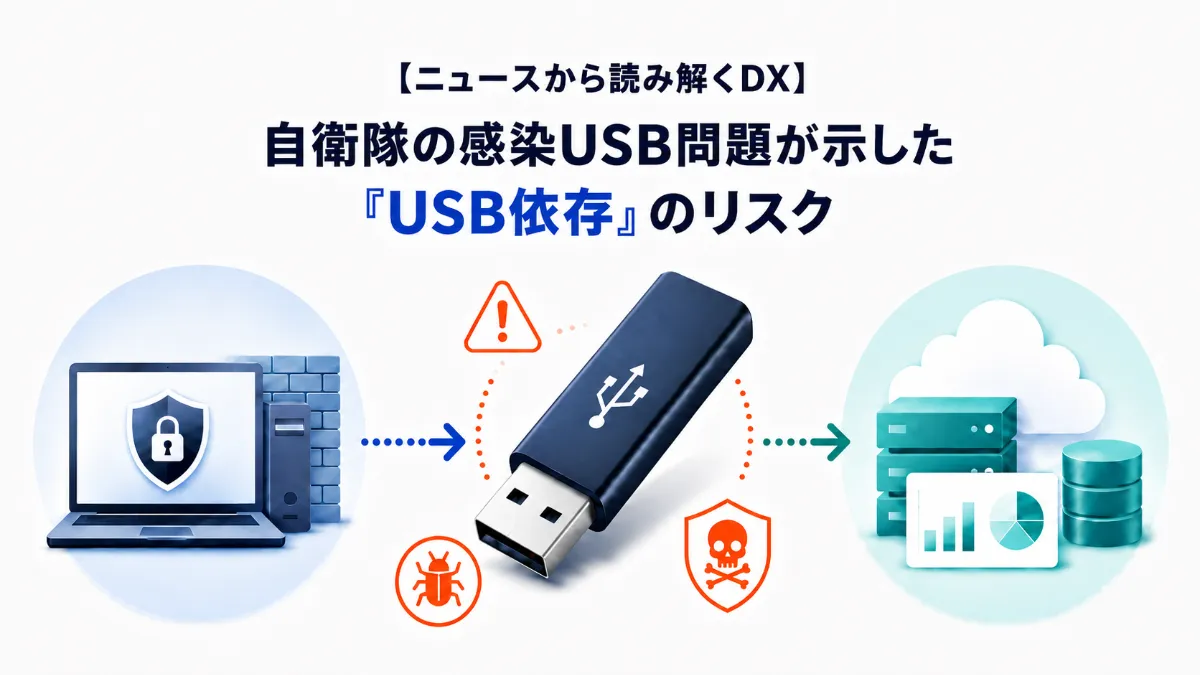
In June 2026, the Nikkei reported that a USB memory device infected with a Chinese virus was connected to classified system terminals in the Japan Ground Self-Defense Force and used for nearly a year. According to the report, the infected USB memory was connected to multiple terminals, some of which were used in closed systems handling highly confidential information such as unit command and control.
This news represents a serious cybersecurity issue and also contains important points from the perspective of . The question is how to safely move data in environments isolated from networks. In , attention tends to focus on themes such as AI, cloud, and data analysis. However, if data generated in cannot be moved safely, it cannot be utilized further.
This article uses the Self-Defense Force's infected USB issue as a starting point to organize the challenges of data transfer in network-isolated environments, and considers the role of 's IoT data transfer service as a new alternative to USB memory.
What the infected USB issue revealed
■What happened in the Self-Defense Force
According to reports, the Japan Ground Self-Defense Force's systems are operated separately between open systems connected to the Internet and closed systems handling highly confidential information. Such network isolation is an important measure to prevent external attacks and information leaks. On the other hand, data needs to be exchanged between systems for operational purposes, and USB memory has been routinely used as the means to do so.
In this incident, infected USB memory was connected to multiple terminals, some of which were used in closed systems. The problematic USB memory was reportedly a counterfeit Chinese product, with an inexpensive microSD card embedded instead of genuine memory chips.
USB memory is a convenient and handy tool. However, this case shows that behind that convenience lie risks stemming from the procurement manufacturing distribution process of USB memory itself, as well as challenges such as malware infection and inconsistent usage management.
■Not just a Self-Defense Force problem
The risks associated with USB memory are not limited to the Self-Defense Force. Related Nikkei reports indicate that similar infected USB memory may have spread to general society through online shopping and other channels. At least 25 cases of suspected virus contamination have been reported in Japan and the US, with infections confirmed even in equipment at factories and laboratories with strict security.
In other words, this is not a problem that occurs only in highly specialized environments such as defense. Factories, laboratories, medical institutions, educational institutions, financial institutions, and others also use systems isolated from networks and devices that cannot easily connect to the cloud. In such , recording media such as USB memory and DVDs are sometimes used as means to transfer data externally.
Network isolation is effective in preventing external attacks. However, data must be moved to advance operations and research. The USB memory that has long served as this bridge can itself become an entry point for attacks—this is the important implication of this news.
Why must we rely on USB memory
■The dilemma of network isolation and data utilization
In systems isolated from networks, there are constraints on data exchange with the outside. To protect confidentiality, network connections cannot be made easily. On the other hand, data must be moved to other PCs or servers to advance operations and research. In other words, faces the dilemma of not connecting for safety, but wanting to move data for utilization .
Recording media such as USB memory and DVDs have filled this gap. However, as this news shows, physical media also have risks. The media itself may be counterfeit, or malware may be embedded. Furthermore, if usage history and transfer history are not adequately managed, tracking becomes difficult when problems occur.
In the future , rather than the binary choice of connecting to a network or carrying with recording media such as USB memory , mechanisms that safely move data even in constrained environments are required.
■Four risks lurking in data transfer via USB memory
Recording media such as USB memory and DVDs have long been used as means to extract data from devices that cannot connect to networks. However, such recording media have the following risks despite their convenience.
- Loss theft riskUSB memory and DVDs are small and portable, but they are also media that are easily dropped or stolen. If confidential data is contained, the damage from information leaks becomes significant.
- Malware infection riskEven if networks are blocked, if physically bringing in recording media such as infected USB memory, security barriers collapse. Such recording media create another entry point into environments that are supposed to be protected from external networks.
- Inefficiency of large-capacity data transferResearch data, inspection data, video files, etc. can range from several GB to several tens of GB. Copying or moving to recording media takes time, and the effort of media exchange increases.
- Human errorFile copy omissions, overwrite mistakes, wrong transfer destinations, etc.—the more dependent on manual work, the more likely errors occur. If work is left to individual staff members, history management also becomes difficult.
The problem of data transfer via USB memory is not simply a story of using dangerous media . It is a bottleneck in where security, work efficiency, data management, and operational burden overlap.
as an alternative to USB memory
■USB memory prohibition alone does not solve the problem
The point to consider from this news is not the prohibition of USB memory use. Not using suspicious USB memory, confirming procurement channels, and thoroughly checking for viruses are of course important. However, the need to move data continues to remain in .
In factories, laboratories, medical institutions, etc., equipment isolated from networks and devices that cannot easily connect to the cloud are still used. In such , simply deciding not to use USB memory may stop operations and research. What is needed is an alternative means to safely move data without relying on USB memory.
■What is
One option for such challenges is 's IoT data transfer service . is a data transfer service born from joint research between and the University of Tokyo Information Technology Center. It aims to realize rapid and safe data migration without manual work via USB memory or DVDs, even in non-network environments requiring large capacity high security.
At the center is the data transfer IoT device -01 . By connecting -01 to devices with network restrictions, data that was previously extracted with USB memory can be transferred to cloud storage, internal servers, etc.
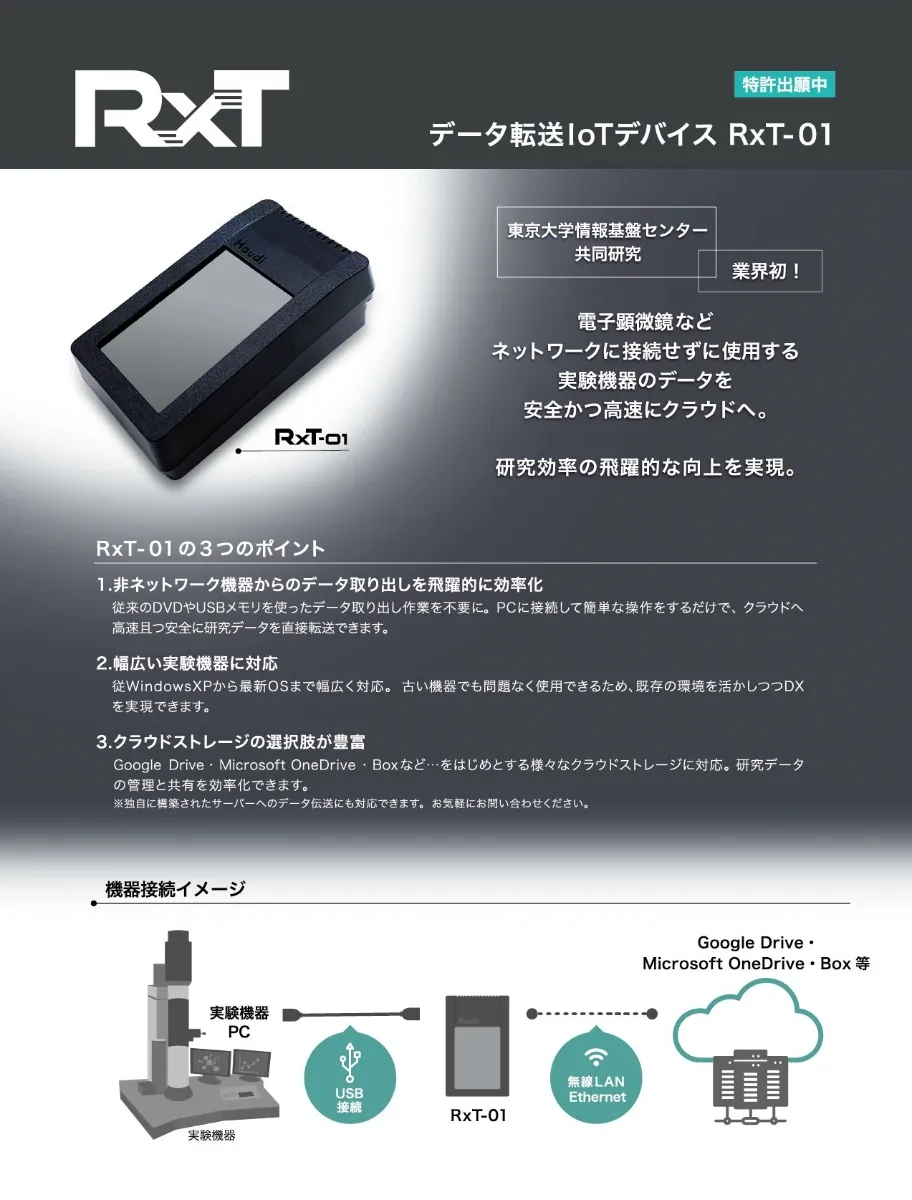
The detailed mechanism of is also introduced in the following materials.
■Value that brings to
The value of lies in replacing the role that USB memory has played of extracting data from network-isolated environments with a more manageable mechanism that considers safety. Expected applications include experimental equipment at universities research institutions, manufacturing plant facilities, medical institution testing equipment, defense security fields, and corporate research facilities. There are devices difficult to connect to networks, but data needs to be utilized—it supports such .
As this news showed, USB memory can become an entry point for malware infection. Even if networks are blocked, if physically bringing in infected USB memory, security risks are unavoidable. becomes an option to reduce such risks by reviewing the operation itself of people carrying USB memory to move data.
In handling large-capacity data, copying or moving to recording media and uploading from another PC takes considerable time. If data transfer can be systematized via -01, the burden of manual work can be reduced, and lead time reduction until data utilization can be expected. Furthermore, if the need for people to carry USB memory can be reduced, risks of loss or theft can be suppressed. If manual copying and uploading can be reduced, it also leads to reduction of human errors such as copy omissions and overwrite mistakes.
-01 is recognized as a USB disk by experimental equipment, etc., so it is an easy-to-introduce mechanism for offline devices equipped with USB drivers. It is also characterized by being able to reduce data transfer effort without major modification of existing equipment.
Summary
The Self-Defense Force's infected USB issue cannot be dismissed as mere USB memory management negligence. It shows challenges common to many that handle data in environments isolated from networks. From the perspective of , it is important to connect data generated in to a state where it can be utilized safely, reliably, and continuously. What this news highlighted is, in addition to the vulnerability of the familiar tool called USB memory, the reality that stops at its foundation if there is no mechanism to safely move data.
's can be a new option for safely moving data while considering safety in environments that have had to rely on USB memory.
Reference articles:
Nikkei Self-Defense Force connects infected USB to classified system, Chinese virus undetected for a year
Nikkei Infected USB beyond Self-Defense Force, spreading to society through online shopping factories laboratories, etc.
Nikkei USB survey at all municipalities, Ministry of Internal Affairs early in month, manufacturer and quantity, measures in response to Ground Self-Defense Force issue
Related information:
begins sales of data transfer IoT device -01 born from joint research with the University of Tokyo