


The Ministry of Economy, Trade and Industry published the " Product Security Measures Guide for SMEs Developing IoT Devices " in June 2023. This guide is primarily aimed at SMEs developing IoT devices and other products, outlining security measures to protect products from cyberattacks. Here, we introduce an overview of the guide to help you grasp its overall content.
Background and Purpose of Guide Development
In recent years, the spread of IoT device adoption has been remarkable, with utilization advancing at an astonishing speed from workplaces to homes. Along with the rapid increase in users, there is concern about the lack of awareness regarding threats lurking in IoT devices, and it has become a problem that even companies developing IoT devices have insufficient security measures in some cases.
Under these circumstances, the threat of cyberattacks on IoT devices has increased, and as part of countermeasures, the Ministry of Economy, Trade and Industry developed the " Product Security Measures Guide for SMEs Developing IoT Devices ". Although multiple guidelines and standards have been presented before, there were voices saying " we don't know where to start ". This guide was compiled in response to such needs, with a focus on " measures that companies attempting to implement IoT device security should tackle as a first step .
In SMEs, resources such as budget and personnel are often limited, and security measures tend to have low priority among management issues. Therefore, this guide considers management understanding essential, placing SME executives at the top of the intended readers, and is formulated for security personnel, • development personnel, • and quality managers.
Guide Overview
We introduce key points excerpted from the guide for each item.
Measures Required in Each Phase
The guide divides the device development lifecycle into four phases: ① policy • structure building, ② design • development, ③ verification, and ④ operation • maintenance, and indicates what should be considered first as security measures.
① Policy • Structure Building
[Measure 1] Formulate • disseminate security policies for products
- Executives should take the lead in formulating security policies for products and ensure they permeate the company through public relations and education.
- Review policies based on implementation status and changes in social requirements.
[Measure 2] Establish a structure for properly operating security policies
- Identify the stakeholders and organizations necessary for properly operating security policies, and clarify their respective roles and responsibilities.
② Design • Development
[Measure 3] Identify what should be protected in IoT devices, etc., and anticipate risks to them
- Define anticipated users and use cases.
- Consider users' security needs and identify what should be protected.
- Anticipate diverse risks to what should be protected.
[Measure 4] Conduct design • development considering what should be protected and risks
- Based on the risks anticipated in Measure 3, implement risk countermeasures in IoT devices, etc., from the design • development stage.
- If in-house implementation is difficult, it is also effective to receive advice from experts such as device verification service providers regarding security considerations in the design • development stage.
③ Verification
[Measure 5] Verify that security requirements are met
- Establish a verification plan from the design • development stage, verify that security requirements are met, and make improvements based on the results.
④ Operation • Maintenance
[Measure 6] Continue collecting risk information and communicating with stakeholders after shipment, and provide appropriate support
- Collect information on accidents, incidents, and vulnerabilities occurring in the world. If vulnerabilities exist in your products or components, examine the possibility and impact of damage caused by the vulnerabilities, and consider responses according to the risks. If problems are found with your products, provide information appropriately and respond with security patches.
- To provide information that serves as a reference when selecting products and promote proper use, clearly describe security functions and precautions for use (including support periods and disposal) on packages, instruction manuals, websites containing product information, etc.
- Establish contact points for appropriate communication with outsourcing partners and users, and for exchanging information on vulnerabilities and incidents with JPCERT/CC.
At the beginning of each measure, " risks that could occur if measures are not implemented " are listed, creating a structure that allows concrete visualization of risks while conveying the importance of measures. To further deepen understanding, many related reference materials and columns are also included.
Main Technical Measures to Consider in Design • Development Phase
Regarding measures in the design • development stage, technical measures are indicated in more detail for each function provided by IoT devices. This is because current IoT devices have diverse functions such as acquiring and converting location, • temperature, • motion, etc., into data, and controlling other devices. As with the previous section, these are all measures to be considered first, so select appropriate measures and work on implementation.
① IoT Devices, etc., Providing Communication Functions
A) Provision of Authentication • Authorization Functions
- Provide authentication • authorization functions for IoT device, etc., users.
- Provide communication destination authentication functions for IoT devices, etc.
B) Provision of Update Functions
- Assuming new vulnerabilities will be detected after shipment, enable software and firmware updates.
C) Provision of Log Storage Functions
- Store logs of important operations and communications of IoT devices, etc.
② IoT Devices, etc., with Data Transmission • Storage Functions
A) Provision of Data Encryption • Protection Functions
- Enable encryption of users' personal data, configuration data, and privacy-related data for storage • transmission.
B) Provision of Data Deletion Functions
- Enable deletion of personal data, configuration data, and privacy-related data when users finish using IoT devices, etc., and dispose of, return, etc., them.
③ IoT Devices, etc., Requiring High Availability
A) Provision of System Recovery
- For functions requiring high availability, provide recovery methods for when functions stop.
B) Provision of Anomaly Detection Functions
- Provide functions that can detect operational anomalies in IoT devices, etc.
Case Studies of Measures by SMEs Developing IoT Devices
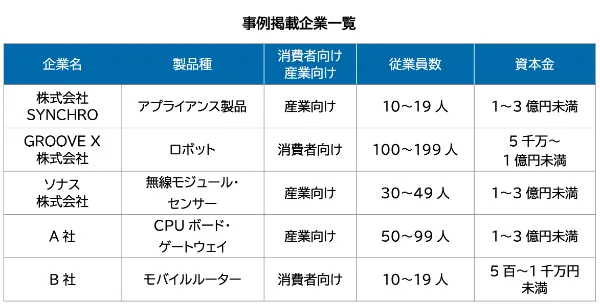
Five SMEs are featured as actual case studies. Following basic information about the companies and products, key points of measures, measure details, and benefits of emphasizing measures are concisely summarized, allowing an overview of what measures are appropriate for each company.
Summary
This guide has content befitting its purpose of encouraging SMEs to take the first step in IoT device security measures, making it an easy-to-understand and reference guide regardless of position. To implement responsible security measures as a company developing IoT devices, make good use of this guide that supports your first step.
" Product Security Measures Guide for SMEs Developing IoT Devices " (Ministry of Economy, Trade and Industry)
" Product Security Measures Guide [Summary Version] " (Ministry of Economy, Trade and Industry)
Please also read these articles.