


As the impacts of global warming become increasingly severe on a global scale and reducing greenhouse gases becomes an urgent issue, the term "GX" is being heard more frequently. Here, we clarify the meaning of GX and explain initiatives being advanced by governments and private companies, as well as its relationship with DX.
What is GX?
GX is an abbreviation for Green Transformation. It means transitioning away from fossil fuels that generate greenhouse gases to clean energy sources such as solar and wind power, while viewing these efforts as opportunities for economic growth and transforming society as a whole.
Currently, governments and private companies worldwide, as well as citizens, are working to reduce greenhouse gases that cause global warming. The Japanese government has also declared its commitment to achieving "carbon neutrality", aiming for net-zero greenhouse gas emissions by 2050.
To achieve carbon neutrality and aim for a decarbonized society, the very structure of society that has depended on fossil fuels since the Industrial Revolution must change. A positive attitude is needed to view this as a growth strategy, enhance industrial competitiveness, and lead to economic growth. GX can be considered a "transformation of the entire economic and social system" to simultaneously achieve greenhouse gas reduction and economic growth.
What is Carbon Neutrality?
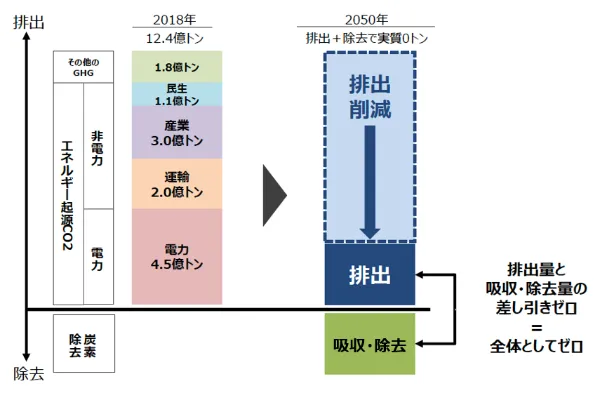
Carbon neutrality means subtracting the amount of greenhouse gases absorbed from the amount emitted to achieve a balance of zero (neutral). The absorption amount here includes not only the amount absorbed through afforestation and forest management, but also the amount removed through technologies such as capture and underground storage. Carbon neutrality is the state where these absorption amounts are subtracted from greenhouse gas emissions, resulting in an overall zero (same as net zero or real zero).
While efforts continue to reduce greenhouse gas emissions themselves, the concept of carbon neutrality aiming for net zero has spread as a more realistic approach, since some sectors find it difficult to reach zero. As of 2021, over 140 countries worldwide have declared "carbon neutrality by 2050".
Difference Between Carbon Neutrality and Decarbonization
Greenhouse gases are gases with the property of absorbing heat in the atmosphere, such as carbon dioxide (CO2), methane, nitrous oxide, and fluorocarbons. "Carbon neutrality" is the concept of targeting all greenhouse gases and aiming for net zero through a balance of emissions and absorption. On the other hand, "decarbonization" focuses on CO2, which accounts for approximately 75% of greenhouse gases, with the goal of zero CO2 emissions.
However, since "decarbonization" has no clear definition and the future that both "carbon neutrality" and "decarbonization" aim for is the same "decarbonized society" achieving zero CO2 emissions, these two terms are used interchangeably in many contexts.
Measures to Achieve Carbon Neutrality
Achieving carbon neutrality requires efforts in both emissions and absorption. Regarding emissions, decarbonization in the power generation sector, which accounts for a large proportion, is a prerequisite, but various measures including energy conservation and electrification are advancing. We will also introduce specific examples, including new technologies, for measures to increase absorption that can offset emissions.
Decarbonization of Power Sources
In power generation, which has large CO2 emissions, it is essential to transition to power sources that do not emit CO2, and the movement to introduce renewable energy such as solar, wind, and geothermal power is becoming active. Since solar and wind power have the weakness of being affected by weather, improvements in battery storage performance are also being pursued.
Nuclear power is one power source that does not emit CO2 during generation and can be reused, but there is a current situation where it is difficult to increase dependence due to safety being a prerequisite. Additionally, at existing thermal power plants, efforts are being made to reduce CO2 emissions by mixing hydrogen and ammonia with fuel for combustion, and to achieve decarbonization by combining with CO2 capture technology.
Energy Conversion • Promotion of Electrification
Even in sectors other than power generation, CO2 emissions are being reduced by converting energy sources to lower-carbon options, hydrogen, biomass, synthetic fuels, etc. In railways, operations utilizing 100% renewable energy have begun, and devices that efficiently convert energy are also being manufactured.
At the center of energy conversion measures is electrification. Electrification is advancing in familiar areas, such as from gasoline-powered cars to EVs (electric vehicles) and from gas stoves to IH cooking heaters. Since promoting electrification increases electricity consumption, there is an urgent need to advance it in tandem with decarbonization of power sources themselves.
Energy Conservation • Improving Energy Efficiency
As a measure toward carbon neutrality, reducing energy consumption itself can be said to be the most fundamental approach. Energy conservation measures to reduce energy consumption are considered the first priority in all sectors.
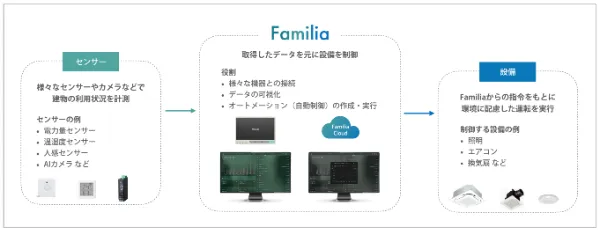
Among energy conservation measures, particularly electricity conservation is beginning to show significant results through the use of digital technology. Digital energy conservation is being realized from industry to every corner of daily life, and its effects may be easier to understand by imagining smart homes and smart buildings, which have been increasing in recent years. Development of highly energy-efficient products is also advancing, with effects expected to reduce energy consumption. In all cases, digitalization and DX play major roles, as described later.
Increasing Absorption • Removal
Activities are being conducted to increase absorption of atmospheric carbon dioxide used in photosynthesis by advancing forest maintenance centered on afforestation. Additionally, efforts to reduce atmospheric carbon dioxide using technologies called "negative emission technologies" have begun, including "DACCS", a technology that directly captures and stores atmospheric carbon dioxide, and "BECCS", a technology that captures carbon dioxide emitted when using biomass fuel and stores it underground. CO2-absorbing concrete has also been put into practical use.
The Key to Achieving GX Lies in DX ~ "Green Growth Strategy Accompanying 2050 Carbon Neutrality"
In 2020, Japan declared "2050 carbon neutrality" and formulated the "Green Growth Strategy Accompanying 2050 Carbon Neutrality", led by the Ministry of Economy, Trade and Industry. It states that, with decarbonization of the power sector as a prerequisite, "energy-saving effects through digitalization greatly contribute to all industries (omitted) and it is necessary to promote digitalization and digital transformation (DX) in all industrial sectors".
Furthermore, it calls the efficiency • CO2 reduction of energy demand through digitalization "Green by Digital", explaining that "the advancement of digitalization leads to efficient energy use • CO2 reduction through optimization of the flow of people • goods • money". Specific examples include achieving 80% energy savings by moving corporate systems to the cloud, and reducing energy associated with travel through telework • online meetings.
Summary
Efforts to achieve GX need to advance in combination, centered on transitioning to clean energy that does not emit CO2 based on the concept of carbon neutrality, along with promoting electrification, energy conservation, and development of decarbonization technologies. Rather, we should view this as an opportunity for economic growth and actively engage in it, including promoting DX.
"Green Growth Strategy Accompanying 2050 Carbon Neutrality"(Ministry of Economy, Trade and Industry)