

As nationwide efforts toward smart cities advance, ICT (Information and Communication Technology) is becoming increasingly important in urban development. Here, we first explain what smart cities are, and then introduce IoT technology and its functions, which are indispensable for realizing smart cities among ICT technologies.
What is a Smart City?
A smart city refers to an urban area or region that utilizes advanced technologies such as ICT to solve various challenges and aims to improve convenience and comfort for all people, including residents and businesses.
In smart cities, data is collected by deploying sensors and cameras throughout the area, integrated and analyzed by AI. By remotely controlling equipment • devices as needed, infrastructure • facilities • operations are optimized. Solutions are expected for challenges such as energy management, public safety, monitoring of elderly and children, traffic congestion relief, and disaster preparedness.
Internationally, smart city initiatives began in Europe in the 2000s, with Spain • Barcelona leading the way. While Japan lagged behind, in 2021 the Cabinet Office • Ministry of Internal Affairs and Communications • Ministry of Economy, Trade and Industry • Ministry of Land, Infrastructure, Transport and Tourism jointly compiled the " Smart City Guidebook " to accelerate progress toward realizing smart cities. Public-private partnerships have also begun.
Reference:Latest Smart City Trends: How Far the World Has Advanced!
IoT Supporting Smart Cities
In smart cities, various ICT technologies are utilized. Among them, IoT technology, alongside AI, big data, and communication network technologies, is an indispensable technology for realizing smart cities.
IoT (Internet of Things) is an abbreviation for " Internet of Things " and refers to a system that connects various objects to the internet to exchange data. While IoT targets are broad and diverse, including home appliances, automobiles, robots, sensors, and smart speakers, in smart cities, the following IoT devices are primarily utilized and serve as urban infrastructure.
Sensors • Cameras
In many cities where smart city initiatives are advancing, sensors and cameras serving various roles are installed throughout the city, collecting and managing data via the internet, and contributing to various public services.
In disaster prevention, sensors and cameras are installed in rivers to detect water level information and provide disaster information to residents in real time. For crime prevention, security cameras and sensors are installed in Stations areas, facilities • parks, etc., to monitor outdoor information and people flow. They are also useful for monitoring elderly and children, with some municipalities introducing beacon tags (BLE tags) and cameras together.
In public facilities, sensors and cameras detect temperature, humidity, presence or absence of people • number of people, and automatically control air conditioning systems and lighting equipment. This not only maintains optimal indoor environments at all times but also visualizes energy consumption to contribute to energy conservation.
In smart cities currently leading overseas, sensors and cameras play a major role in solving transportation challenges, achieving traffic congestion relief, automation of traffic enforcement, and efficient parking space management. Cameras installed on major roads detect traffic conditions and control traffic signals as needed to ease congestion. Cameras and speed sensors automate speed violation enforcement. For parking space management on roadways, parking sensors embedded in the street work to allow residents to check availability via smartphone apps, and parking violation checks are also automated.
Smart Meters
Smart meters are meters equipped with communication functions. They automatically read usage of electricity, gas, etc., and notify remotely via communication lines, while also having various other functions.
In smart cities, data from smart meters visualizes energy consumption, enabling optimal energy management. Energy-saving effects are already emerging in many public facilities. In emergencies or disasters, gas leaks are detected early and shut off remotely. Remote opening is also possible during recovery, enabling early restoration. They greatly contribute to urban safety and convenience.
Reference:Gas Meters Go Smart Too! Following Electricity, Smart Meters Spread
Smart Trash Bins
Smart trash bins, which have begun spreading in recent years mainly at city street corners, are trash bins with built-in IoT sensors. They automatically compress when full, and real-time monitoring of waste accumulation enables priority collection of full bins. This solution maintains city aesthetics while improving waste collection efficiency. Some types have solar panels to eliminate electricity costs, adding no burden in terms of energy consumption.
Reference:What is IoT Utilization Contributing to SDGs? From SDGs Meaning to Implementation Examples
Smart Poles
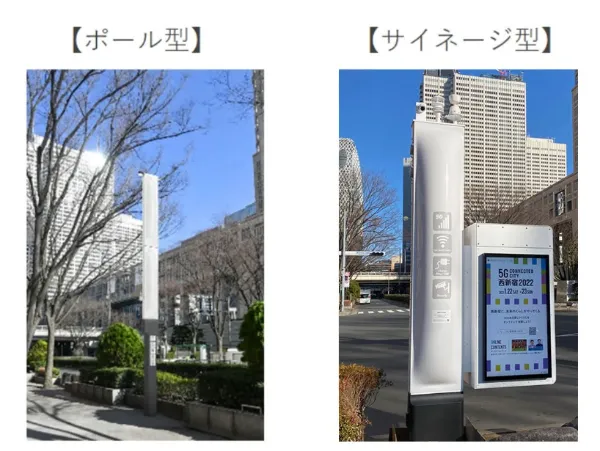
Smart poles are new urban infrastructure equipped with multiple functions including 5G base stations, high-speed Wi-Fi, emergency batteries, sensors • cameras, and digital signage. There are two types by shape: pole type and signage type. In Japan, installation began in Nishi-Shinjuku in 2020.
Smart poles use sensors to collect weather information and measure air pollutants, and cameras for crime prevention and monitoring congestion. Types equipped with digital signage disseminate information necessary for public safety and security, such as local information, disaster information, and heatstroke alerts.
Summary
It is no exaggeration to say that ICT technologies, including IoT, form the foundation of smart cities. We hope to see urban development that is highly convenient, safe, secure, and comfortable for both residents and businesses by wisely incorporating and utilizing ever-evolving IoT devices.