

Automatic doors have already become established in our daily lives and are now indispensable facilities. They are a prime example of universal design that is easy for everyone to use, regardless of whether they are wheelchair users, people carrying luggage, or any other passersby. Here, we will examine the benefits of automatic doors from a universal design perspective, introduce automatic doors that are being improved through the use of ICT, and present the " Mirairo Door " developed with our company's participation.
Automatic Doors and Universal Design
In Japan, over 2 million automatic doors are currently in operation. They are installed as standard in all types of facilities, including office buildings, commercial facilities, public facilities, and hospitals, making automatic doors one of the essential infrastructure elements in society today. When considering universal design in buildings, automatic doors used by everyone play a significant role and are facilities that can greatly contribute to realizing universal design.
Universal Design refers to design that is easy to understand and use for all people regardless of differences in physical ability, age, gender, nationality, etc., or the concept behind such design. Automatic doors have long been regarded as a prime example of universal design due to their fundamental functions.
Automatic doors are not only convenient facilities for people with disabilities, but more broadly offer convenience for all users. Since they eliminate the need for actions such as turning knobs or pushing heavy doors, they are easy-to-use facilities for all people, not limited to wheelchair users, visually impaired people, and elderly people, but also including people pushing strollers and people carrying luggage in both hands. In other words, automatic doors are not specially provided for specific individuals, but are universal design intended for all passersby.
Universal Design • Barrier-Free • Inclusive Design
Universal design targets all people and designs things to be easy for everyone to use " from the start ". In contrast, barrier-free aims to remove barriers that hinder elderly people and people with disabilities in their social lives, removing barriers " after the fact ".
Inclusive design, which has become commonly heard in recent years, is a method that involves (includes) people such as elderly people and people with disabilities—who have traditionally tended to be excluded from the design process—from the beginning of the design process to design together. It shares common ground with universal design in aiming for design that is easy for everyone to use.
Automatic Doors Evolving with ICT
In initiatives aimed at universal design, unprecedented solutions are continuously emerging and improvements are advancing through the latest ICT technologies, and facilities, services, and other offerings that are kind and easy to use for all people are being realized. Automatic doors are no exception.
In automatic doors, sensors act as eyes to detect people's approach. In the past, " floor-mat type " sensors that react to people's weight and heat-ray sensors that react to temperature changes from people's approach were common, and cases of failure to detect people occurred frequently. Currently, new sensors have been developed and are being introduced due to advances in sensing technology, and safety has also greatly improved.
In current mainstream automatic doors, the following sensors are utilized to activate door opening and ensure the safety of people passing through doors or people who have stopped near doors.
- Light Beam Emission Type • Radio Wave Type (detects people and objects by reflection of microwaves or infrared rays)
- Light Beam Reflection Type (prevents the door from closing when detecting people or objects by infrared reflection)
- Photoelectric Type (installed on both sides of the door, prevents the door from closing while the light beam is interrupted)
- Ultrasonic Type (monitors the area by emitting ultrasonic waves and prevents the door from closing when detecting people or objects)
Automatic Door Kind to All People " Mirairo Door "
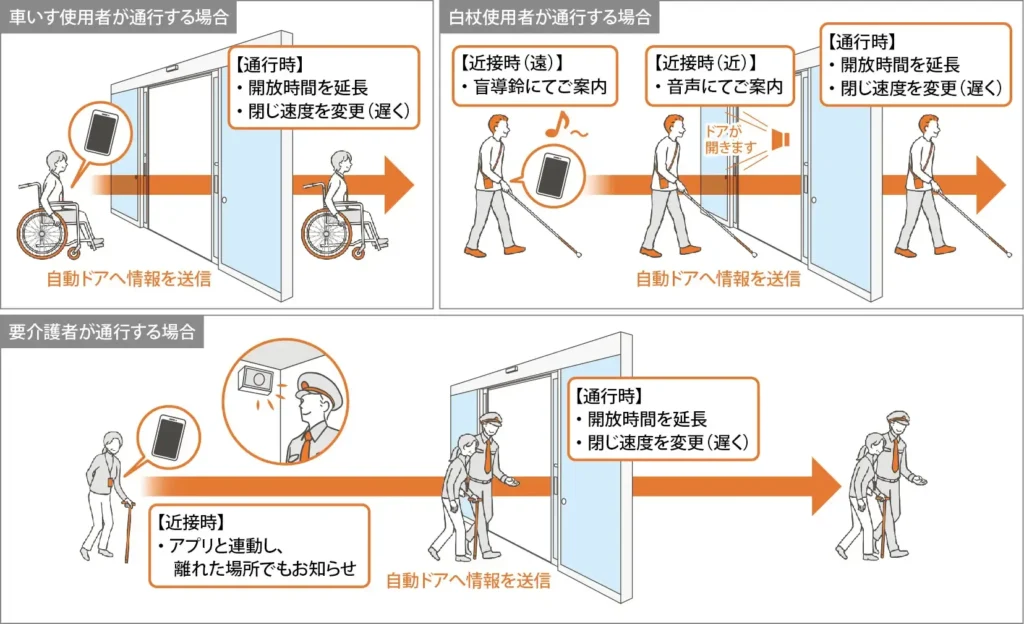
Through further utilization of ICT, a new generation of automatic doors has also emerged. The " Mirairo Door ", developed jointly by our company Haudi, Mirairo Inc., and Frutec Co., Ltd., enables changing the opening and closing method for each individual passerby through smartphone integration, and makes support such as voice guidance for visually impaired people possible. Since optimal operations are performed for each individual, the convenience and safety of automatic doors have dramatically increased.
Summary
With the revised Act on Eliminating Discrimination against Persons with Disabilities enforced on April 1, 2024, the provision of reasonable accommodation for people with disabilities has become mandatory for private businesses as well. As responses are urgently needed in many spaces such as commercial facilities and office buildings, the introduction of automatic doors, a flagship of universal design, will likely advance. It is certainly worth knowing about the latest trends in automatic doors, which continue to evolve through the use of ICT.