

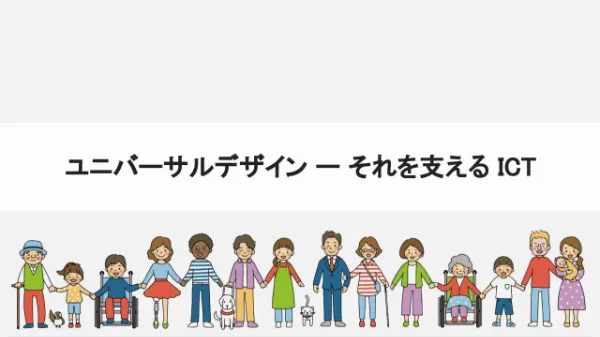
In a society where people of all ages, genders, and diverse characteristics live together, efforts to create things that are easy for everyone to use are accelerating. A key term in this context is " universal design ", which has become increasingly familiar in recent years. This article explains what universal design is and how ICT is involved in realizing universal design.
What is Universal Design?
Universal design refers to design that is easy to understand and use for everyone, regardless of differences in physical ability, age, gender, nationality, etc., or the concept behind such design. It is sometimes abbreviated as " UD " using its initials.
Universal design applies to everything from " physical objects " such as facilities and products to " information " such as signs, printed materials, and web media. Examples of universal design for " physical objects " include automatic doors, ramps, handrails, multipurpose restrooms, and scissors that work for either hand, while examples of universal design for " information " include pictograms, signage with color-conscious design, home appliances with voice guidance, and Stations announcements and displays. All of these are universal designs that are easy for anyone to use, regardless of the user.
The Difference Between Universal Design and Barrier-Free
A term often confused with universal design is barrier-free. Barrier-free aims to remove obstacles (barriers) that hinder elderly people and people with disabilities in their social lives. In other words, it can be described as an effort to remove barriers " after the fact " for specific groups such as the elderly and people with disabilities.
Universal design, on the other hand, targets everyone and designs things to be easy for anyone to use " from the beginning ". Rather than treating elderly people and people with disabilities specially and modifying existing things, universal design aims from the start of the design process to create forms that are easy for everyone to use.
Universal Design Realized by ICT
While universal design covers a wide range of subjects and various approaches exist, in recent years, through the use of ICT (*), many challenges are being overcome in innovative ways. The latest ICT technologies are continuously creating unprecedented solutions, realizing facilities, services, and equipment that are friendly and easy to use for everyone.
* ICT (Information and Communication Technology) refers to " information and communication technology ". Like IT, it refers to communication technologies such as the Internet and hardware • software, and is also widely used in relation to services and industries. In recent years, ICT has been actively used in place of IT.
For example, Mirairo Inc., which employs many people with disabilities, uses ICT to its fullest to create a universal design environment where everyone can thrive. Wheelchair users can work while communicating with employees in the office from home or elsewhere, employees with visual impairments can perform computer work comparable to non-disabled people using screen readers and braille displays, and employees with hearing impairments actively participate in training and meetings by utilizing applications that convert speech to text and remote sign language interpretation. This is an excellent example of how ICT demonstrates its power in realizing universal design.
Specific Examples of Universal Design Using ICT
Here are examples of universal design using ICT.
Automatic Doors
A representative example of universal design is the automatic door seen at entrances to condominiums and supermarkets. Already familiar in our daily lives for a long time, these automatic doors are also universal design facilities that provide convenience to everyone. Since they eliminate the need to turn a knob or push a heavy door, they are easy-to-use facilities for all people, not only wheelchair users, people with visual impairments, and the elderly, but also people pushing strollers and people carrying items in both hands.
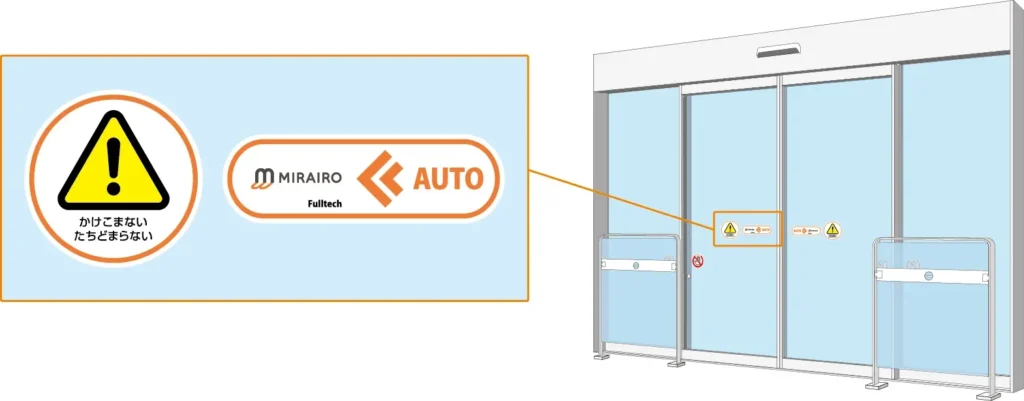
The functionality of automatic doors continues to evolve, and new-generation automatic doors utilizing ICT are emerging. " Mirairo Door ", developed jointly by our company Haudi, Mirairo Inc., and Fulltech Co., Ltd., can change the opening and closing method for each individual user and provides support such as voice guidance for people with visual impairments. Because optimal operations are performed for each individual, it enhances the convenience and safety of automatic doors.
Reference:Japan's First! Development of " Mirairo Door ", a New-Generation Automatic Door Friendly to Everyone
Sensor-Activated Faucets
With sensor-activated faucets, water flows automatically when hands are brought close, as the sensor responds. Anyone can use them comfortably, including people with hand disabilities, children and elderly people with weak grip strength. They also have the advantage of being hygienic since there is no need to touch the faucet as with twist-type faucets.
Smartphones
Smartphones, which have become daily necessities, are perhaps the most familiar ICT devices. From a universal design perspective, they are equipped with many desirable features thanks to ICT. They allow customization of text size, volume, screen brightness, etc., according to individual needs, and also include speech-to-text and text-to-speech functions for people with visual or hearing impairments. With advancing foreign language support, they are becoming increasingly convenient tools for everyone.
Smart Home Appliances • Smart Homes
Smart home appliances and smart homes utilizing AI and IoT make people's lives convenient and comfortable by connecting appliances to the Internet, and have become particularly significant innovations for elderly people and people with disabilities who have physical limitations. Traditionally, some operation was required to control devices, but through smart speakers, for example, room lighting, TV power, radio, music, etc., can be operated simply by speaking. This can be said to be a field where the effects of ICT utilization are significant.
Education Sites
In education Sites as well, the concept of universal design has come to be emphasized, and as a tool for this purpose, schools that have achieved one device per student with computers and tablet devices are steadily increasing. It has been reported that using one device per student has enabled lessons tailored to individuals. Additionally, online classes have been developed in response to the COVID-19 pandemic, providing a means to guarantee learning for students who cannot attend school.
Summary
Universal design is already steadily permeating familiar areas, and furthermore, it is expected to expand even more through the advancement and utilization of ICT in the future. It is also an essential initiative for Japan as it enters a super-aged society, and something everyone should engage with as their own concern.