

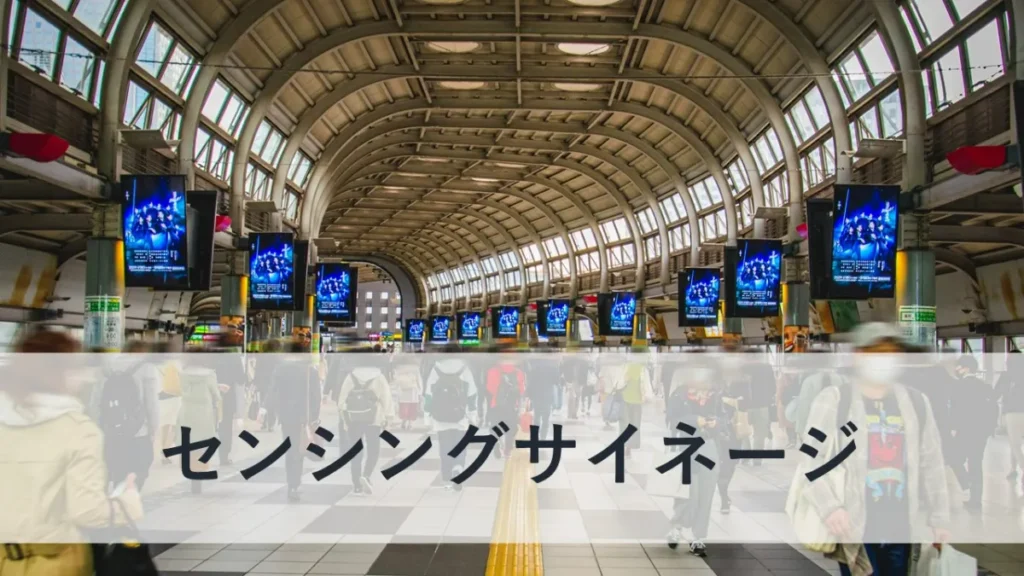
Digital display devices such as screens have become increasingly prominent in train cars and stations, as well as in stores and on streets, replacing poster advertisements and signboards. Sensing signage has been attracting attention in recent years as a system for delivering optimal content to these displays. Here, we introduce the overview and key considerations of sensing signage, along with the latest implementation examples.
What is Sensing Signage
Sensing signage can be described as an evolved form of digital signage (*). By incorporating sensing technology into digital signage and utilizing data collected by IoT devices such as AI cameras and sensors, sensing signage can display timely and appropriate content.
* Digital signage, also called electronic signboards, is a system that delivers content such as advertisements and information using digital display devices. It is installed in various locations including transportation facilities, stores, offices, and public facilities. The content displayed is generally delivered in a pre-programmed sequence and order.
Sensing signage uses cameras and sensor devices to collect data such as the gender, age group, number of people nearby, weather, temperature, and humidity. Based on this data, advertising content can be flexibly changed or reflected in information displays.
For advertising-purpose signage, for example, advertisements for cold beverages can be displayed on hot days, or beauty and cosmetics advertisements when there are many women. Signage that displays real-time congestion status of stores and offices detected by cameras has also been realized.
Points to Note with Sensing Signage
Essential to implementing sensing signage is consideration for privacy. This is because many people feel uncomfortable being watched by cameras, and there are concerns that sensors may collect various data without their knowledge and use it inappropriately.
Based on these considerations, the Sensing Signage Guidelines (Digital Signage Consortium) and the Camera Image Utilization Guidebook Ver.2.0 (IoT Promotion Consortium, Ministry of Internal Affairs and Communications, Ministry of Economy, Trade and Industry) were compiled. When implementing sensing signage, it is important to protect privacy in accordance with these two guidelines.
Sensing Signage Guidelines compliant sensing signage does not record video captured by cameras. Only anonymized data is utilized, with measures in place to prevent personal identification or leakage of personal information. Additionally, properly operated sensing signage is permitted to display a symbol mark upon application, serving as an indicator.
Digital Signage ConsortiumQuoted from
Implementation Examples
Sensing signage is being implemented across a wide range of fields as an efficient and effective advertising delivery method and information guide. Let's look at specific examples.
Inside Railway Vehicles
Saitama Rapid Railway has been progressively installing sensing signage Dynamic Vehicle Screen above doors inside vehicles since November 2019, and began full-scale operation in April 2020. This is the world's first initiative inside railway vehicles.
Saitama Rapid Railway:Saitama Rapid Railway New Vehicle Vision 'Dynamic Vehicle Screen' Begins Full Commercial Operation from April
Dynamic Vehicle Screen collects data such as temperature, humidity, congestion status, and passenger attributes inside the vehicle using cameras and sensors mounted in the unit, analyzes it with AI, and displays advertisements in real time, switching according to the situation inside the vehicle. In addition to advertisements, it can also provide train delay, suspension and other operation information, weather information, and disaster information. Since late January 2023, it has been delivering weather forecasts by the Japan Weather Association.
Office
Sensing signage has been implemented at CROSS LAB for Smart City, a co-creation facility opened by NTT Communications in April 2021. Data on current congestion status, seating status, and environmental information (temperature, humidity, carbon dioxide concentration) is collected from cameras and sensors installed in the lab, and displayed on screens in coordination with the Smart Data Platform for City system. It is installed near the entrance/exit gate to provide information to users.
NTT Communications:CROSS LAB for Smart City
Smart Building
At Tokyo Portcity Takeshiba, which opened in September 2020, AI cameras are installed in all stores in the commercial facility. Displays installed at approximately 30 locations throughout the building have a system that can display real-time congestion status of shops and restrooms based on data from the cameras.
Tokyo Portcity Takeshiba:Smart Building
Retail Stores
In retail stores, sensing signage that recognizes the gender and age group of visitors using cameras set on displays and automatically switches content accordingly is widely utilized. Since content that visitors are more likely to prefer can be displayed, it contributes to sales promotion.
Street Signage
Sensing signage that delivers content tailored to passersby on street advertising displays has also emerged. As one example, the drugstore Ainz & Tulpe Shinjuku East Exit Store determines the gender of passersby with a camera installed above the display and broadcasts interactive content accordingly to attract customers.
Summary
Sensing signage has expanded the possibilities of digital signage through integration with sensing technology. It brings new value to both advertising delivery and information guidance. While it is expected to be widely implemented in the future, including consideration in smart city initiatives, development that adheres to guidelines and is accepted with confidence by society is desired.