

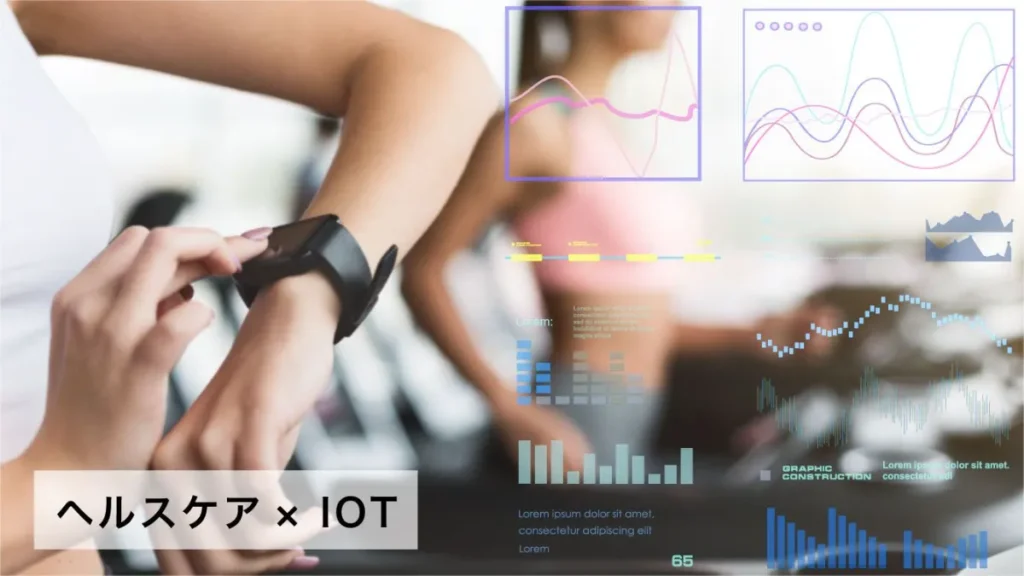
With growing health consciousness, more people want to monitor their daily physical condition and manage their health themselves. This is made possible by IoT devices such as smartwatches, which are now being adopted by companies and organizations. Here, we explain the benefits and details of introducing IoT devices in the wellness and healthcare fields.
Benefits of IoT Adoption in Healthcare
With the advancement of digital technology, many IoT devices that can acquire health data have emerged. Around the same time, societal needs for healthcare to maintain • and manage health have also increased. As a result, the adoption of IoT devices in the healthcare field is now progressing rapidly.
Consequently, healthcare is undergoing significant qualitative evolution. Let's examine the benefits of adoption.
" Visualizing " Health Status
Wearable devices such as smartwatches collect biometric data like body temperature and blood pressure while worn. Since they can measure automatically for long periods including during sleep, they enable accurate monitoring of daily health status.
Wearable devices = Wearable is a term meaning " something that can be worn ", referring to IoT devices and computers that can be attached to the body such as wrists, arms, neck, or clothing. As internet-connected devices, measured data can be easily recorded • and managed in apps, " visualizing " health status in an easy-to-understand format.
Easy Disease Prevention and Health Management
Wearable devices are available at prices accessible to general consumers. Also, since they can be worn comfortably at all times like a wristwatch without stress, biometric data can be easily collected daily. This makes it easier to understand health status, making disease prevention and health management relatively easy even at the individual level.
Remote Monitoring Enabled
Remote monitoring becomes possible for subjects of concern such as elderly parents living apart or family members recuperating at home. A major advantage unique to IoT devices is the ability to check detailed data on health status, not just confirm safety.
What Can Be Measured with IoT Devices
Various health-related biometric data can be acquired through wearable devices and IoT sensors. Wearable devices in particular are designed to be worn comfortably for long periods, making it possible to measure values during exercise and sleep.
The following values can primarily be measured:
- Sleep status (sleep duration, sleep depth, etc.)
- Activity level
- Step count
- Calories burned
- Heart rate/pulse rate
- Body temperature
- Blood pressure
- Blood oxygen level
IoT Devices Used for Health Management
We introduce smartwatches, bed sensors, and smart shirts as IoT devices primarily intended for health management.
Smartwatches
Smartwatches are the quintessential wearable device. Many models are already available, including the Apple Watch. While these devices have diverse functions, they are also well-equipped with features useful for health management.
As devices worn on the wrist, they provide information such as step count, heart rate, electrocardiogram, blood oxygen level, and sleep data, based on which they also measure calories burned and activity level. To facilitate data recording and management, they are linked with compatible smartphones.
Bed Sensors
The latest bed sensors can be installed under mattresses to collect sleep-related data. They primarily detect and record sleep cycles, heart rate, and snoring with sensors. These devices are distinct from the bed-exit sensors traditionally used mainly in nursing facilities.
Detected data is automatically sent to smartphones via the internet. Upon waking, you can receive data that affects sleep quality, such as sleep duration, sleep depth, time taken to fall asleep and wake up, number of nighttime awakenings, and sleep regularity.
Furthermore, they can be linked with other devices to function as switches that automate actions before and after sleep. For example, they can be set to automatically turn off lights when you get into bed, or automatically adjust air conditioner temperature upon waking—extended functions unique to IoT devices.
Smart Shirts
As a type of wearable device, smart shirts that measure biometric data simply by wearing them like T-shirts or innerwear are gaining attention. Developed by textile manufacturers and others, they are stretch wear equipped with sensors.
They can measure heart rate, temperature and humidity inside clothing, activity level, step count, posture, and more. Data is transferred via the internet to smartphones or PCs for recording and review.
They can predict heat-related health issues for heatstroke prevention, and enable accident prevention and conditioning management during exercise through heart rate monitoring. Use is envisioned not only by individuals but also by companies and organizations whose members exercise or work in hot conditions.
Summary
The wave of digitalization is bringing major transformation to the wellness and healthcare fields. In particular, the emergence of convenient and user-friendly IoT devices is powerfully promoting the visualization of health status. We should further advance adoption and utilize these devices for disease prevention and health management.