

There is a growing movement to create office spaces that prioritize well-being by utilizing various smart technologies. While many factors such as air, temperature • humidity, light, and sound are involved in creating a healthy and comfortable office space, this article will focus on temperature • humidity to explore solutions for enhancing office comfort.
Temperature • Humidity and Well-being
Well-being is a concept that refers to a state of physical • mental • social health and fulfillment. Improving well-being in the office means creating an environment where workers can work in good physical and mental health and with social satisfaction.
Reference:What is Well-being? Explaining the Well-being That Offices Should Aim For
Room temperature is one of the factors that determines the office environment. Everyone has experienced how heat and cold affect concentration and motivation. IWBI, which operates " WELL certification ", a new office standard, has published data showing that work performance decreases by an average of 15% when the office feels hot and by an average of 14% when it feels cold.
In other words, to create a comfortable and productive office space, it is important to manage temperature • humidity to ensure thermal comfort (*). Temperature • humidity are unavoidable factors in pursuing office well-being.
* Thermal comfort refers to comfort in the thermal environment, indicating a state that is neither hot nor cold and free from discomfort. It varies based on conditions such as air temperature and humidity, as well as radiation, airflow, activity level, and clothing.
Solutions for Temperature • Humidity Management
Many solutions have been developed to ensure thermal comfort in offices, primarily by appropriately controlling temperature • humidity. We will introduce solutions that mainly utilize smart technology.
• Visualizing Temperature • Humidity with IoT Sensors " "
Using various IoT sensors, temperature • humidity are continuously monitored, and air quality is assessed along with data such as CO2 concentration and PM2.5 levels in the air. Data is stored in the cloud via Wi-Fi and the internet, and can be displayed and checked on PCs, smartphones, and digital signage.
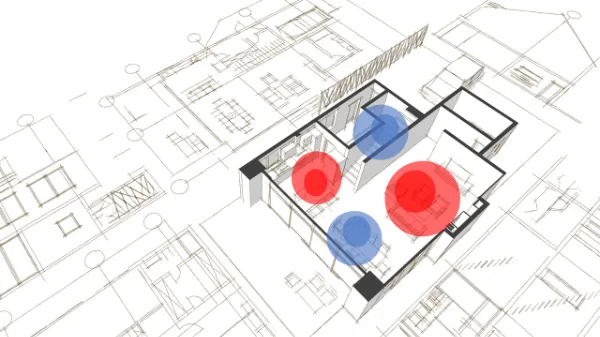
Temperature • humidity display formats include numerical displays as well as image displays that express temperature with colors, advancing visualization.
• Automatic Control Systems for Air Conditioning Equipment
This is a system where various sensors and air conditioning equipment are connected via a network, allowing automatic control of air conditioners and other equipment based on sensor data. Some systems use beacons worn by individuals to detect occupancy and make fine adjustments. In shared spaces such as lounges, the system works with motion sensors to relax temperature settings when no users are present, achieving both energy savings and comfortable spaces.
• Remote Control via IoT Technology
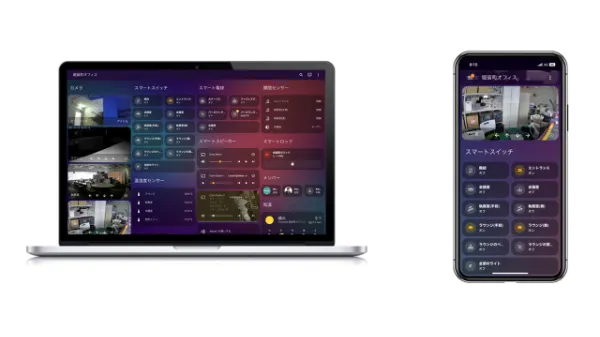
It is also possible to remotely control air conditioning from PCs or smartphones while checking temperature • humidity on the system. This allows individuals to enjoy comfort from the moment they arrive at work, for example.
• Visualizing Temperature • Humidity × Free Address
Air conditioning preferences and sensations vary greatly among individuals. In offices with a free address work style where individual seats are not assigned, each person can choose and work in their preferred temperature environment. To enable this, temperature differences are deliberately created within the floor and visualized with temperature and humidity monitors.
• Individual Air Conditioning Systems
Air conditioning systems that can be adjusted by floor, room, or even by zone within each room are expanding to achieve comfort at a more individual level. The latest IoT technology enables automatic system control, and remote operation from outside is also possible using smartphones and other devices.
• Underfloor Air Distribution • Radiant Cooling and Heating with Thermal Mass
Air conditioning equipment is also evolving in diverse ways, with underfloor air distribution systems seeing increased adoption in recent years. This mechanism blows conditioned air up from beneath a raised floor structure, achieving efficient and highly comfortable air conditioning. It can also be combined with thermal mass storage that uses nighttime electricity to store heat in concrete slabs.
Summary
If temperature • humidity can be properly managed, office comfort will greatly improve and directly contribute to a better work environment. While air conditioning equipment tends to attract attention only from an energy-saving perspective, we should also find and implement solutions appropriate for each facility to improve office well-being. With advances in smart technology, new developments are progressing. Let's continue to pay attention.