

To create a comfortable and productive office environment that considers well-being, efforts toward improvement are necessary across various conditions such as air, temperature, • humidity, light, and sound. In this article, we will focus on light and sound, examining their relationship with well-being and solutions that primarily utilize smart technology.
" Light " and Well-being
Solutions Related to " Light "
Well-being is a concept that refers to a state of physical, • mental, • and social health and fulfillment. Improving well-being in the office means aiming to create an environment where workers can work in good physical and mental health and with social satisfaction.
Reference:What is Well-being? Explaining the Well-being That Offices Should Aim For
One of the factors that influences this office environment is " light ". It is known that not only natural light but all types of light affect people's physical and mental health, and for office well-being, it is important to appropriately utilize natural light and lighting.
Efforts to improve office lighting have traditionally focused on energy conservation, but from a well-being perspective, many new solutions are emerging.
• Circadian Lighting
Lighting that approximates natural light to align with the circadian rhythm (*) inherent in the human body is called " circadian lighting ". While it is difficult to receive sufficient natural light in office spaces, LED lighting makes it possible to create lighting that approximates natural light by adjusting the amount of light (brightness) and light color (color temperature).
*Circadian rhythm refers to the approximately 24-hour cycle inherent in living organisms, including humans. It is also called the diurnal rhythm. It regulates body temperature, • blood pressure, • autonomic nervous system, • hormone secretion, and other functions, and prolonged disruption of this rhythm can adversely affect health, including sleep. While maintaining a regular lifestyle is fundamental to keeping the rhythm normal, it is known that light plays a major role, such as exposure to morning sunlight and reducing light at night.
Lighting equipped with dimming • and color tuning functions expresses the transition of light from morning to noon, dusk, and night through changes in brightness and color temperature. Specifically, the office is set to high illuminance • and high color temperature in the morning, and the illuminance and color temperature are gradually reduced in the afternoon. Even with artificial lighting, by reproducing light changes similar to natural light, the aim is to maintain the circadian rhythm of office workers while preserving the brightness necessary for work.
• Lighting Control Systems
By networking lighting, not only can lighting be managed efficiently, but comfort is also improved. Through integration with various sensors, lighting can now be finely adjusted to the necessary brightness. The goal is to achieve dimming and switching off without causing discomfort to space users, balancing energy conservation and comfort.
• Task • and Ambient Lighting
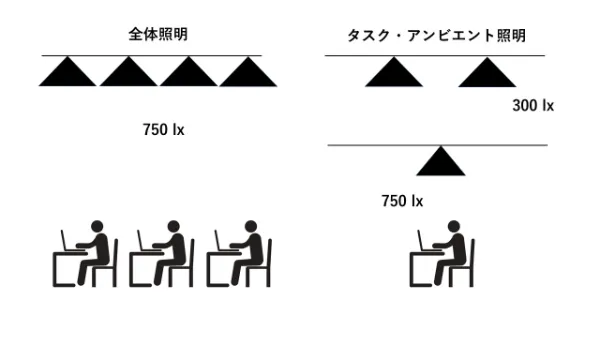
Task • and ambient lighting is the Japanese translation of " Task (work) and Ambient (surroundings) Lighting ". It refers to a lighting style that combines multiple types of lighting to brighten only the necessary areas according to the work location or task. Unlike conventional lighting methods that uniformly brighten every corner of a room with only ceiling-mounted general lighting, this approach is said to create an efficient and comfortable office environment because it easily accommodates individual needs. Integration with various sensors is also advancing.
Implementation Examples
• IRIS Group Tokyo Antenna Office
Lighting in the office is controlled by a wireless lighting control system. Circadian lighting is adopted, with dimming • and color tuning performed according to the time of day. For example, for 30 minutes from the start of work, bright daylight-colored light activates the body, and after work hours, the color temperature and illuminance are gradually reduced to encourage departure. Additionally, lighting is controlled according to the characteristics of each area to create an environment suited to work styles. Through these efforts, the office has obtained " WELL Certification v2 ", an evaluation system focused on well-being.
Reference:What is WELL Certification? Introducing New Standards for Office Spaces
• Shimizu Corporation Hokuriku Branch New Building
Aiming for human-centered lighting, the lighting design achieves a high level of both energy efficiency and health and comfort through circadian lighting, task • and ambient lighting, and daylight utilization.
" Sound " and Well-being
Offices are filled with various sounds, including air conditioning noise, ringtones, and voices. Annoying noise and loud sounds distract attention and interfere with concentration. They reduce productivity and cause stress for workers, leading to decreased satisfaction. When considering office well-being, it is important to also consider the sound environment.
Solutions Related to " Sound "
Among annoying sounds, voices are said to be the most bothersome. Let's look at solutions that reduce discomfort from noise, including other types of noise.
• Sound Masking
A system that prevents sound and conversation from leaking by deliberately playing other sounds in spaces where sound is generated, such as conference rooms, is called " sound masking ". It is a mechanism that cancels sound with sound, and environmental sounds such as air conditioning noise or the murmur of a stream are often used. Sound masking has the effect of preventing interference with the concentration of people working nearby and making highly confidential conversations less audible to others.
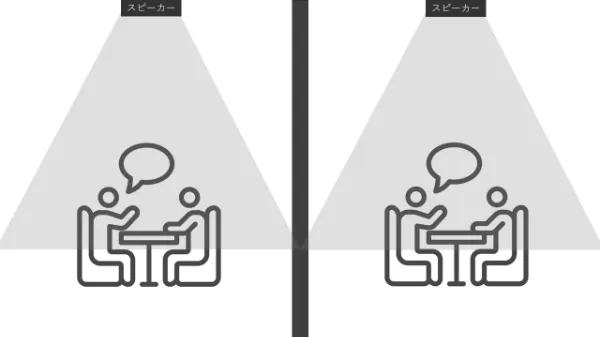
For smart workplaces with layouts where individual spaces and shared spaces are adjacent, systems have emerged that link with individual location information to emit masking sounds only where and when needed.
• Sound Environment Design
The sound environment is greatly improved by using soundproof • and sound-absorbing wall materials that suppress sound diffusion and reverberation. Sound environment conditions suited to each need can be examined using simulation tools that utilize 3D CAD data from the initial design stage.
Implementation Examples
• Konica Minolta Japan e-base3
This office features a layout with conference rooms and individual booths dedicated to web conferences grouped together in the center, surrounded by free-address work spaces. Sound masking is adopted, with speakers installed facing upward on top of the partitions of conference rooms and individual booths to make voices leaking from conference rooms difficult to hear.
Furthermore, speakers are also set up in open spaces, aiming to enhance work concentration and comfort. Forest sounds including pleasant birdsong are played in the business meeting space, sounds like those in a lively café in the meeting space, and the murmur of a stream in the relaxation space at the back, aiming to activate communication.
• Panasonic • System Solutions Development Center
A building completed in 1981 was renovated in 2018, and environmental zoning using light and sound was introduced in the third-floor office area. The brightness • and color of lighting and the type of background music are changed depending on location and time of day, allowing workers to choose work areas according to work content and mood, aiming to create a comfortable office environment.
Summary
Among the factors that influence office comfort, light and sound have become areas of attention in recent years, with new solutions emerging from a well-being perspective. As work styles diversify, the required office environment is also changing, but we should understand the role of light and sound in spaces and actively work on these aspects.