


In recent years, IoT has been rapidly spreading across all fields, and while it offers great convenience, damage caused by inadequate security measures has been increasing and becoming a problem. Here, particularly for those involved in IoT device development, we explain the threats lurking in IoT and their countermeasures to help you recognize the importance of security measures. In this first part, we introduce specific damage cases, focusing on the nature of threats.
Threats Lurking in IoT and Security Measures
When devices and services connect to the Internet, it means creating contact points with the outside world through the Internet. Therefore, if there are security vulnerabilities in IoT devices, risks arise of security breaches from outside through the Internet or becoming targets of cyberattacks.
When developing IoT devices, it is essential to understand that IoT carries such threats and to implement appropriate security measures.
Disadvantages for IoT Device Manufacturers as Well
If IoT devices developed • and manufactured lack sufficient security measures, not only can they cause damage to users, but manufacturers may also suffer disadvantages. There are cases requiring recall responses or leading to lawsuits, becoming management-related issues. From a management perspective, one should be aware of the importance of security measures for IoT devices.
What Are the Threats Lurking in IoT? Using Smart Homes as an Example
The first step in security measures for IoT devices is to clarify and recognize what threats exist in which locations. Let's look at this specifically using smart homes as an example.
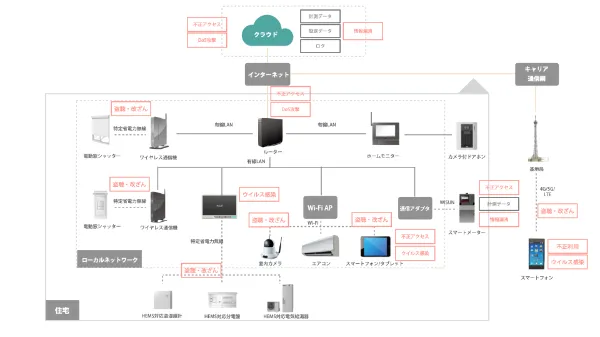
The above diagram models an example of a smart home. It illustrates a state where HEMS-compatible devices and network-compatible devices are connected to the Internet via a home router, centered on a HEMS(*) controller. From outside locations, you can access devices in the home via cloud services using a smartphone, making it possible to monitor the status of home devices and remotely control them.
*HEMS (Home Energy Management System) is a system that controls household power supply and demand, aiming for energy conservation by centrally managing compatible devices.
In this system, the following threats are considered to be lurking.
- Unauthorized Access (Unauthorized Use)
- Information Leakage
- Eavesdropping • Tampering
- DoS Attacks
- Virus Infection
If unauthorized access is allowed, there is a risk of not only personal information leakage but also financial • and physical damage from misuse of acquired data.
Threats Expected by Location
Let's look at the threats expected in smart homes by location.
Cloud Services
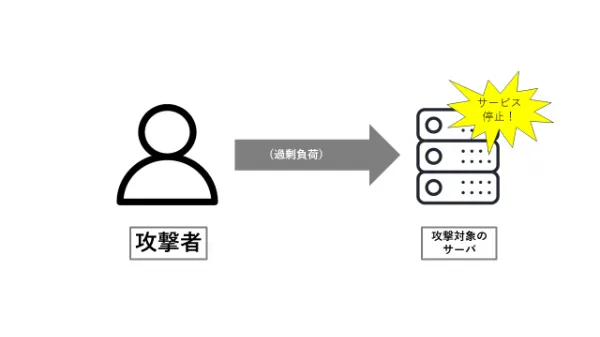
If the IP address and port number of a cloud server are identified, it becomes a trigger for unauthorized access, exposing the system to all kinds of threats. When subjected to DoS attacks that send large amounts of access or data to impose load, unprotected cloud servers will become unresponsive or stop. Information leakage of various data stored on cloud servers can also occur.
HEMS Controller
Besides eavesdropping • and tampering of data in communication paths, virus infection threats are expected.
In virus infections, IoT devices are hijacked by external attacks and unknowingly used as relay points (stepping stones) for attacks on other IoT devices or sites, which has become a problem. While being a victim of " stepping stone attacks " by malicious third parties, there is also the risk of participating in cyberattacks.
Home Router
There are threats of unauthorized access and DoS attacks. When subjected to DoS attacks, home routers will become unresponsive or stop.
Wireless Communication • Mobile Communication
In communication paths, threats of data eavesdropping • and tampering are expected.
Network Cameras
Through unauthorized access, damage such as camera image theft, image data tampering, or deletion can occur. DoS attacks on cameras, home routers, or cloud servers can make cameras inaccessible, and virus infections may lead to use in stepping stone attacks.
Smartphones • Tablet Devices • PCs
Dangers of unauthorized use through unauthorized access and virus infection are conceivable.
Smart Meters
Through unauthorized access, information leakage of measurement data is expected.
Attack Cases Targeting IoT Devices
We introduce cases where IoT devices became targets of cyberattacks and damage occurred.
DDoS Attacks Through Malware Infection
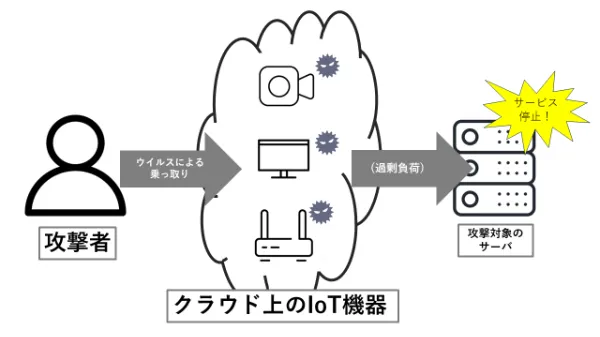
In 2016, a DDoS attack was launched against a website operated by a certain celebrity First Name from approximately 180,000 IoT devices infected with the malware " Mirai ". A DDoS attack is a cyberattack where attackers hijack a large number of computers and launch a simultaneous attack. It brings down servers by increasing the load.
The devices infected with the virus were IoT devices connected to networks with insufficient security settings and measures, and even with subsequently emerging viruses, attacks targeting vulnerable IoT devices have been repeated.
Attacks Targeting Network Cameras
In recent years, network cameras being installed as surveillance cameras have increasingly become targets. Cases have occurred where the mechanism allowing remote camera image viewing through the Internet is exploited to steal or tamper with camera image data, and even disable functions. In 2018, surveillance cameras for rivers and other areas in multiple domestic municipalities were subjected to unauthorized access.
Summary
When developing IoT devices, it is necessary to implement security measures appropriate to each device. As the first step toward this, in this first part, we have looked specifically at threats lurking in IoT devices. By knowing what threats exist in which locations, you can connect to necessary countermeasures. In the second part, we will explain countermeasures against threats.
*