

As climate change countermeasures become urgent, GX (Green Transformation) is attracting attention as an important transformation for the future. Playing a central role in this is the spread of renewable energy. This article explains how GX and renewable energy interact with each other and lead to the realization of a carbon-neutral society, while also touching on corporate efforts to reduce carbon footprints.
The Role of GX and the Position of Renewable Energy
GX refers to comprehensive transformation that leads society as a whole toward carbon neutrality through initiatives that achieve economic growth while reducing greenhouse gas emissions. To realize this, it is necessary to accelerate the spread of renewable energy by utilizing policy support and technological innovation.
Policy Support and Investment Promotion
In May 2022, Prime Minister Kishida announced the realization of public-private GX investment exceeding 150 trillion yen over the next 10 years. Toward this goal, the issuance of " GX Economic Transition Bonds " (Decarbonization Growth-Oriented Economic Structure Transition Bonds) on a scale of 20 trillion yen has been decided. This measure is expected to advance capital investment in GX-related projects, promote decarbonization efforts by companies and local governments, and facilitate renewable energy adoption.
Introduction of Carbon Pricing
Carbon pricing is a mechanism for paying " fees " according to the amount of greenhouse gas emissions, including carbon dioxide (CO2), and has been adopted in many countries including EU nations, Canada, Australia, Japan, and South Korea. Since costs can be reduced by decreasing emissions, it motivates companies to work on emission reduction. It also encourages renewable energy use as it becomes economically advantageous.
Promotion of Technological Innovation
Technological innovation is essential for realizing GX. Power supply and demand management through smart grids (*) and stable supply of renewable energy using storage batteries are attracting attention. Supply-demand balance adjustment technology utilizing AI and IoT is also supporting the realization of a carbon-neutral society.
*A smart grid is a next-generation power grid that utilizes information and communication technology to efficiently manage the supply-demand balance of electricity.
Impact on Regional Economies
Renewable energy adoption promotes regional energy self-sufficiency and contributes to revitalizing regional economies. Microgrids (*) and community power generation projects are increasing, advancing decarbonization across entire regions.
*A microgrid is a small-scale power supply system that can operate independently in a specific region or facility. It is characterized by a mechanism that completes power generation • and consumption within the region using renewable energy and storage batteries.
Through these initiatives, GX is accelerating the spread of renewable energy and contributing to the realization of a decarbonized society.
Current Status and Challenges of Renewable Energy Generation
Global Situation
Renewable energy is spreading rapidly, with capacity expected to increase 2.7 times by 2030. Solar and wind power in particular are predicted to account for 95% of renewable energy capacity growth. China accounts for 60% of global renewable energy expansion, with Europe and America also planning to double their capacity.
Japan's Situation
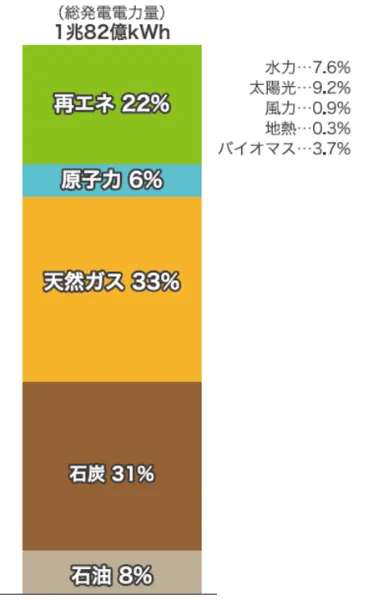
The share of renewable energy in total power generation in 2022 was 21.7%, with the following breakdown:
• Solar: 9.2%
• Hydro: 7.6%
• Biomass: 3.7%
• Wind: 0.9%
• Geothermal: 0.3%
Challenges and Outlook in Japan
Wind and geothermal adoption rates are low, and despite high potential, spread has not progressed due to barriers such as capital investment costs and regional coordination. Supply instability and high initial costs are also major challenges. On the other hand, advances in storage battery technology have enabled storage of surplus power, stabilizing supply. Smart grid technology is making power supply and demand more efficient, and AI-powered supply-demand forecasting is further supporting renewable energy adoption.
Corporate Renewable Energy Utilization and Its Effects
Many companies are utilizing renewable energy in various forms, and this movement is expanding. Specific examples are introduced below.
Domestic Cases
AEON Mall: Installed solar power generation facilities at commercial facilities, realizing a renewable energy self-consumption model.
Tokyu Land Corporation: Currently conducting demonstration experiments " Riene Solar Farm Higashimatsuyama " for agricultural solar power generation (solar sharing) in Higashimatsuyama City, Saitama Prefecture.
Overseas Cases
Google: Achieved 100% renewable energy use at data centers worldwide.
IKEA: Installed solar panels at stores and supplies surplus power to the community.
Renewable energy adoption is a strategic initiative that not only reduces costs and addresses environmental concerns but also directly leads to improved ESG (Environment • Society • Governance) ratings, enhanced competitiveness, and improved brand image.
Corporate Carbon Footprint Reduction Strategies
Carbon footprint refers to the amount of greenhouse gases emitted during the process of production • distribution • and disposal of products and services. Reducing this is essential for companies pursuing environmental response and sustainability.
Success Stories
Bridgestone: Aims to reduce CO2 across the entire product lifecycle through renewable energy adoption and tire technology improvements.
Toyota: Set a target to reduce CO2 from new car sales by 90% compared to 2010.
Nestlé Japan: Expected to reduce annual CO2 emissions by approximately 900 tons in 2024 by switching from truck transport to freight rail transport.
Related Initiatives
Furthermore, the introduction of carbon pricing and demand response (*) is progressing as methods to support corporate carbon footprint reduction. By utilizing these mechanisms, efficient energy use becomes possible, achieving both cost reduction and environmental consideration. As companies aiming for carbon neutrality, they are also making significant contributions to improving corporate value and promoting ESG investment.
*Demand response is a mechanism where the demand side (companies and households) adjusts power consumption when electricity demand increases.
The Future Envisioned by GX and Renewable Energy
The fusion of GX and renewable energy is key to evolving our society toward decarbonization. In smart cities based on renewable energy, systems are being built to efficiently utilize energy generated locally. In cities like Yokohama and Toyota, CO2 emissions reduction is progressing through the use of solar power generation and storage batteries, and regional economies are also being revitalized.
Additionally, in buildings called ZEB (Net • Zero • Energy • Building), efforts are progressing to integrate energy-saving performance and renewable energy technology to achieve zero annual energy consumption. These initiatives symbolize the compatibility of economic growth and decarbonization brought about by GX and renewable energy. Our society will continue to evolve in a sustainable direction through these efforts.
Summary
GX and renewable energy play important roles in supporting the realization of a carbon-neutral society. By leveraging policy support and technological innovation, and through active efforts by companies and regions, it is possible to achieve economic growth while reducing environmental impact. These initiatives will enrich our lives and become the force that opens up a sustainable future.
What is GX? ~ From Carbon Neutrality Initiatives to the Future We Aim For
What is ZEB? ~ Explanation from Basic Knowledge to Subsidy Systems