

Improving energy efficiency and achieving carbon neutrality is one of the most critical challenges in modern architecture and urban development. As a solution, ZEB (Net • Zero • Energy • Building) is attracting attention worldwide. This article introduces basic knowledge about ZEB, success stories, and subsidy programs implemented by national and local governments.
What is ZEB?
ZEB (Net • Zero • Energy • Building) is a building that aims to achieve net zero annual primary energy consumption by combining energy-saving technologies with energy-creation technologies utilizing renewable energy. It maximizes energy efficiency while significantly contributing to achieving carbon neutrality.
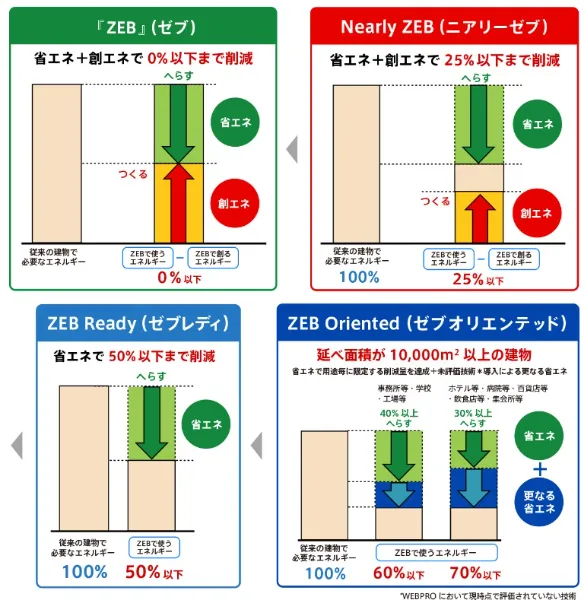
There are mainly four types of ZEB, distinguished by energy reduction rates and the presence or absence of energy creation.
- ZEB
A building with net zero or negative annual primary energy consumption. Achieves 50% or more energy reduction through energy saving and 100% or more including energy creation. - Nearly ZEB
A building close to ZEB. Achieves 50% or more energy reduction through energy saving and 75% or more including energy creation. - ZEB Ready
A building that achieves 50% or more energy reduction through energy saving alone. Does not include energy creation. - ZEB Oriented
A building aiming for ZEB Ready. Achieves 30% or 40% or more energy saving depending on usage. For large-scale buildings.
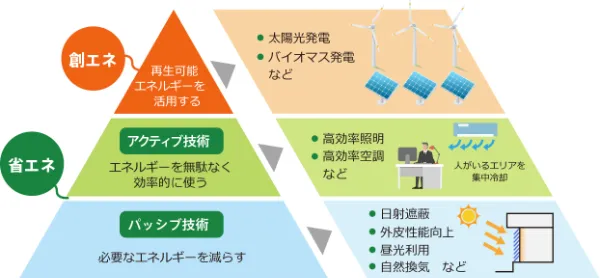
To realize ZEB, it is necessary to combine multiple advanced technologies. For example, to improve insulation performance,high-performance insulation materials and double glazingare used to significantly reduce the energy required for heating and cooling. Furthermore, by introducing anEnergy Management System (EMS)energy use from lighting and air conditioning throughout the building is managed in real time, leading to efficient use without waste. Additionally, as renewable energy,solar power generation panelsare installed to generate the energy required by the building itself, reducing dependence on external energy.
Benefits of Introducing ZEB
Introducing ZEB offers various benefits. The main ones are summarized below.
- Energy Cost Reduction
By combining highly efficient energy-saving technologies with renewable energy, building operating costs can be significantly reduced. For companies and building owners, utility cost reduction is a major attraction. - Environmental Contribution
Significantly reduces CO2 emissions and contributes to preventing global warming. Supports building a sustainable society as an important step toward achieving carbon neutrality. - Comfortable Living Environment
High insulation • high airtightness design creates a stable indoor environment less affected by outside air. This improves comfort for residents and employees, enhancing quality of life and work. - Improved Energy Efficiency Across the City
The spread of ZEB suppresses energy consumption across the entire city and promotes sustainable energy use. Energy efficiency across the city also improves. - Integration with Smart Grid
By integrating ZEB with smart grids (*) and distributed energy systems, efficient energy management across the region becomes more efficient. Energy supply and demand are flexibly adjusted, ensuring stable energy supply.
* A smart grid is a next-generation power system that uses IoT and ICT to bidirectionally manage power supply and demand, achieving efficient and stable energy supply.
ZEB Success Stories
Many commercial and public facilities both domestically and internationally have already been converted to ZEB, achieving both energy efficiency and comfort. Representative domestic examples are introduced below.
Taisei Construction Technology Center ZEB Demonstration Building (Kanagawa Prefecture)
Achieved net zero annual energy balance through a combination of solar power generation and EMS. Operated as an office building, it serves as a model case for ZEB.
Hokkaido Government ZEB Conversion Project
Multiple Hokkaido government buildings, including the Hokkaido Fire Academy building and Nakashibetsu Joint Government Building, have obtained Nearly ZEB and ZEB Ready level certifications. Based on designs and technologies considering cold region characteristics, they utilize energy-saving technologies and renewable energy to maximize energy efficiency in cold regions.
Policies and Subsidy Programs Promoting ZEB
To promote the spread of ZEB, various support measures are being implemented by national and local governments. As a government goal, raising the energy-saving standards for new buildings to ZEB standards by 2030 has been set, and legal systems and guidelines are being developed toward this goal.
As national support measures, the following subsidy programs are being implemented as of fiscal year 2024.
Ministry of the Environment " New Building ZEB Promotion Support Project " " Existing Building ZEB Promotion Support Project "
Targets new • existing commercial facilities of private businesses and local public entities, with subsidy rates of 1/3 to 2/3 for new buildings and up to 2/3 for existing buildings. The subsidy cap is 500 million yen.
Ministry of Economy, Trade and Industry " Residential • Building Supply-Demand Integrated Energy-Saving Investment Promotion Project "
Supports ZEB conversion of large-scale buildings. Targets private new • existing buildings where ZEB design know-how has not been established, with a subsidy rate of 2/3 of eligible expenses and a subsidy cap of 500 million yen per year or 1 billion yen for the entire project in the case of multi-year projects.
Local governments have also established subsidy programs tailored to their regional characteristics, promoting decarbonization through the spread of ZEB. Examples are shown below.
Chiba Prefecture " Commercial Building Decarbonization Design Support Subsidy "
For new construction or renovation aiming to obtain ZEB BELS (Building Energy-efficiency Labeling System) certification, up to 2 million yen is provided according to total floor area.
Sapporo City " ZEB • ZEH-M Design Support Subsidy "
Targets ZEB and ZEH-M (ZEB for condominiums), with subsidies of up to 3 million yen according to total floor area.
Fukuoka City " Decarbonized Building Promotion Support Project "
For buildings aiming for decarbonization within Fukuoka City, up to 3 million yen is subsidized according to total floor area.
Summary
ZEB is an essential element for improving energy efficiency and achieving carbon neutrality. The introduction of ZEB, which combines high-performance energy-saving technologies with renewable energy, brings significant benefits to society as a whole. To build a sustainable and energy-efficient future, further efforts are expected to promote the wider adoption of ZEB.