

For companies promoting energy efficiency, utilizing subsidy programs is an essential element. This article explains major subsidy programs that support energy-saving equipment and renewable energy adoption, and introduces specific success stories of how companies are leveraging subsidies to achieve results.
Significance of Energy Efficiency Through Subsidies
Energy efficiency is an important initiative for companies to achieve cost reduction and environmental impact mitigation. In promoting this, subsidies from national and local governments provide significant assistance.
As policies toward the Energy Conservation Act and carbon neutrality advance, subsidies reduce the burden of initial investment when companies introduce new technologies and equipment, enabling efficient operation. Particularly for small and medium-sized enterprises, this is attracting attention as a means to maximize results with limited resources.
Major Subsidy Programs
We introduce major subsidy programs provided by national and local governments that companies can utilize when promoting energy efficiency. Please note that the content is primarily from fiscal year 2023 (Reiwa 5), so please verify the latest information individually.
[Major Subsidies Provided by the Government]
Energy-Saving Investment Promotion • Demand Structure Transformation Support Project Subsidy (Energy-Saving Subsidy)
This subsidy is utilized when updating aging equipment to high-efficiency energy-saving equipment at existing factories and business establishments. The subsidy rate varies by business category (large enterprises, small and medium-sized enterprises, etc.), but there is potential to receive subsidies of 1/3 to 2/3 of equipment investment costs (subsidy limit of 4 billion yen). It is continuously budgeted annually, with approximately 200 projects adopted each year. The fiscal 2023 supplementary budget is 232.5 billion yen.
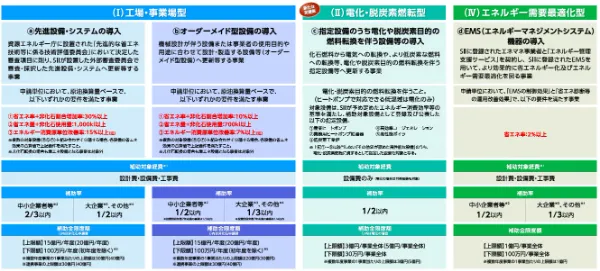
Looking at past adoption results, the following equipment types have high application numbers and adoption rates in the equipment unit category.
• High-efficiency air conditioning • Refrigeration and cold storage equipment • LED lighting fixtures with control functions
In addition, the following equipment is also eligible for subsidies.
• Industrial heat pumps • Commercial water heaters • High-performance boilers • High-efficiency cogeneration • Low-carbon industrial furnaces • Transformers • Industrial motors
Consumer-Led Solar Power Generation • Renewable Energy Power Source with Battery Storage Introduction Support Project Subsidy
This subsidy supports businesses that combine renewable energy generation with battery storage. By installing solar power generation and battery storage together, it enables efficient use of generated electricity to improve regional energy self-sufficiency and contributes to regional economic revitalization.
When consumers cooperate with retail electricity providers or power generation businesses to install solar power generation equipment, a portion of the costs is subsidized. The fiscal 2023 supplementary budget is 16 billion yen, and the fiscal 2024 main budget is 15.8 billion yen, demonstrating the government's continued support commitment.
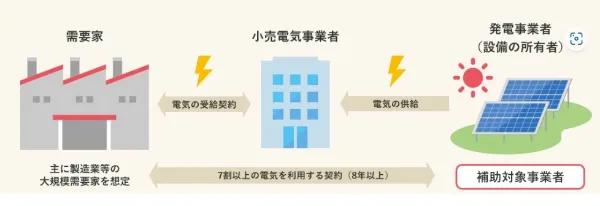
Source:Consumer-Led Solar Power • Battery Storage Introduction Support Office Website
Private Sector Renewable Energy Mainstreaming • Resilience Enhancement Promotion Project
As part of initiatives toward achieving carbon neutrality by 2050, this is a subsidy project implemented by the Ministry of the Environment targeting private companies and others. Aiming for renewable energy mainstreaming and resilience enhancement, it promotes self-consumption • local production and consumption renewable energy adoption, with battery storage (including V2H charging/discharging equipment) installation as a mandatory requirement. 8.211 billion yen is allocated in the fiscal 2023 supplementary budget, and 4 billion yen in the fiscal 2024 budget proposal.
Main initiatives are as follows.
(1) Promoting Price Reduction of Solar Power Generation Equipment, etc. Toward Achieving Storage Parity
Support for introducing self-consumption solar power generation equipment and battery storage in commercial facilities, industrial facilities, apartment buildings, and detached houses
(2) Renewable Energy Equipment Introduction Through New Methods • Price Reduction Promotion
Promotion of solar power generation utilizing solar carports, agricultural land, and reservoirs, and support for introducing building-integrated solar power generation equipment
(3) Renewable Energy Heat Utilization • Power Generation, etc. Price Reduction Promotion
Support for introducing renewable energy heat utilization equipment such as solar heat, biomass heat, and geothermal heat
[Examples of Subsidies Provided by Local Governments (Tokyo)]
Tokyo is actively promoting energy conservation • decarbonization for small and medium-sized enterprises toward realizing Zero Emission Tokyo, deploying multiple energy-saving equipment introduction subsidy programs from fiscal 2023 to 2024.
Energy-Saving Equipment Introduction Toward Zero Emission • Operation Improvement Support Project
In fiscal 2024, five application opportunities are provided, with budgets of 1 to 1.3 billion yen for each round. This project targets high-efficiency air conditioning equipment, LED lighting, high-efficiency boilers, etc., and provides subsidies to companies at rates of 1/2 to 3/4, up to a maximum of 50 million yen.
Energy-Saving Non-Fluorocarbon Equipment Promotion Project
From April 2024 to March 2025, with a budget of approximately 1.2 billion yen, it supports the introduction of environmentally friendly equipment such as refrigerated and frozen showcases and air conditioning chilling units.
Local Production and Consumption Renewable Energy • Energy Storage Equipment Introduction Promotion Project
From fiscal 2024 to 2027, with a budget of 6.66 billion yen, it supports the introduction of renewable energy and energy storage equipment for small and medium-sized enterprises, educational corporations, medical corporations, etc.
Success Stories of Subsidy Utilization
We introduce specific success stories of companies that achieved energy efficiency by utilizing subsidies from national and local governments.
Manufacturing Equipment Efficiency Improvement
Itoman Co., Ltd. in Ehime Prefecture utilized the national " Small and Medium-Sized Enterprises Energy Conservation • Productivity Revolution Investment Promotion Project Subsidy " to update factory compressors and motors. By updating to high-efficiency inverter types, they achieved a reduction in electricity consumption of over 800,000 kwh annually combined.
Koshin Seisakusho Co., Ltd., a metal processing company in Saitama Prefecture, utilized Saitama Prefecture's " Environmental Future Fund Financing " to update aging laser processing machines. By selecting processing machines with excellent energy-saving performance, they became eligible for subsidies. This update significantly reduced annual electricity consumption from 92,519 kwh to 34,842 kwh.
Air Conditioning • Lighting Efficiency Improvement
Yokoyama Seiko Co., Ltd. utilized the national " Energy Use Rationalization Business Support Subsidy " to introduce new air conditioning equipment and LED lighting. By utilizing subsidies, they successfully reduced investment costs to 2/3, and short-term investment recovery is also expected.
Solar Power Generation Introduction
Seto Suisan Co., Ltd. installed solar power generation on the roof of the Kanto Sales Office First Factory in 2022. This introduction enabled them to cover 30% of the factory's electricity consumption. The company utilized Kanagawa Prefecture's subsidy " Kanagawa Smart Energy Plan Promotion Project Subsidy " and established a plan to recover the initial investment in five years.
Summary
By utilizing subsidies, companies can more easily achieve energy efficiency. Introducing energy-saving equipment and renewable energy not only reduces costs but also lowers environmental impact, contributing to a sustainable society. First, assess your company's energy usage situation and verify suitable subsidy programs.