

In the manufacturing industry's Sites, the promotion of DX (Digital Transformation) has become essential against the backdrop of a declining birthrate and aging population, labor shortages, and intensifying global competition. Among these efforts, the use of sensing technology to realize smart factories is attracting particular attention. This article introduces smart factories, which are at the core of manufacturing DX, and the role and implementation examples of the sensing technologies that support them.
Smart Factories Embodying the Evolution of Manufacturing DX
Manufacturing DX is an initiative to efficiently and flexibly transform the entire manufacturing Sites and business processes by utilizing advanced technologies such as IoT and AI. By replacing conventional analog operations with digital ones, it becomes possible to reduce human burden, improve production accuracy, and respond quickly to rapidly changing market needs.
Smart factories are a concrete implementation of such DX. Equipment and systems within the factory are connected via IoT networks, collecting operational information and product data in real time. This data is analyzed by AI and other means to optimize production flow, reduce quality variations, and support business visualization and rapid decision-making.
Supporting these smart factories is sensing technology. It acquires real-time information that is difficult to see, such as equipment operating status, environmental conditions, and product quality changes, playing a central role in smart factories.
Sensing Technology Supporting Equipment Predictive Maintenance
In recent years' manufacturing Sites, the importance of " predictive maintenance ", which detects equipment abnormalities in advance and performs planned maintenance, has been increasing. For this predictive maintenance, the use of sensing technology that can grasp the state of Sites in real time is essential. In particular, vibration sensors that capture minute signs of abnormality without missing them, and acoustic • ultrasonic sensors that can detect high-frequency sounds difficult to perceive by ear, greatly contribute to preventing troubles, saving labor in maintenance work, and reducing costs.
Abnormality Detection and Predictive Maintenance Using Vibration Sensors
Vibration sensors are a core technology for condition monitoring and predictive maintenance of mechanical equipment. For example, a company manufacturing sheet metal parts installed vibration sensors on the dies of progressive press machines. By detecting abnormal vibrations and performing maintenance before breakage, they have succeeded in significantly reducing quality defects and repair time, and avoiding opportunity losses.
Furthermore, in various equipment such as stirrers, vacuum pumps, centrifuges, and die processing machines, vibration data acquired by sensors is analyzed by AI, making it possible to detect minute abnormalities in real time that were often missed by conventional visual inspections. At one factory, by installing wireless vibration sensors, they have achieved early detection of abnormal signs in motors and industrial robots, reducing maintenance costs and improving operating rates.
There are also cases where the condition of rotating machinery is visualized through trend monitoring and FFT analysis, enabling early detection of failure signs such as bearing wear and misalignment, contributing to stable operation through planned maintenance.
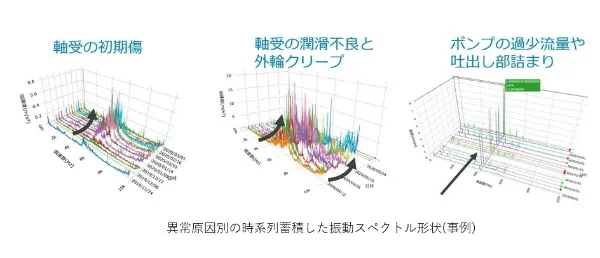
(Source: National Institute of Technology and Evaluation " Smart Safety Technology Catalog ")
Labor Saving and High-Precision Diagnosis Using Acoustic • Ultrasonic Sensors
Acoustic sensors and ultrasonic sensors are another important means in predictive maintenance. These sensors can detect high-frequency sounds that are difficult for the human ear to capture, such as air leaks in compressed air piping and abnormal sounds inside machinery.
For example, ultrasonic diagnostic equipment that captures high-frequency sounds around 40kHz can pinpoint bearing wear and compressed air leak locations, contributing to the efficiency of energy management and predictive maintenance. Furthermore, such equipment is easy to operate and can be handled even by Sites personnel who have not received special training, leading to reduced inspection workload and elimination of work dependency on specific individuals.
With the introduction of such equipment, shortened inspection times and improved accuracy of abnormality diagnosis have been reported, and synergistic effects with energy-saving benefits are also expected.
Sensing Technology Supporting Optimization of Automated Lines
In manufacturing Sites where automation is advancing, advanced detection • control by sensors plays an important role in further enhancing line precision and flexibility. In various processes such as appearance inspection, environmental control, and precision work support, sensors function as the " eyes " and " senses " of robots and control devices.
Automation of Appearance Inspection Using Image Recognition + AI
In the manufacturing industry, automation of appearance inspection combining AI and image recognition technology is advancing. In inspection processes for plastic processed products, automotive parts, metal parts, etc., by utilizing stereo cameras and edge AI devices, it has become possible to detect minute scratches and defects with high precision.
Not only is the inspection burden significantly reduced compared to conventional visual inspection, but the risk of missing defective products is reduced and inspection variations are also suppressed. AI-based image processing contributes to stable operation of inspection processes and improved productivity. At one factory, by introducing image recognition AI, the defect rate improved by several percentage points and the burden on workers was also significantly reduced.
Quality Control and Precision Work Support Through Coordination with Other Sensors
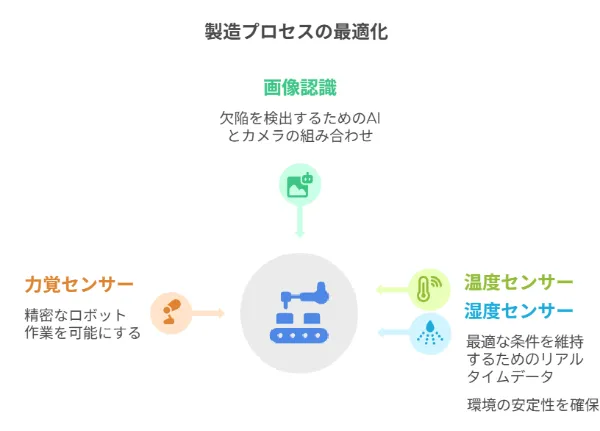
Temperature sensors and humidity sensors are indispensable for quality control in manufacturing Sites. By acquiring environmental data in real time and maintaining optimal production conditions, they contribute to stabilizing product quality and reducing defect rates.
Force sensors, in coordination with industrial robots, enable automation of work requiring delicate force control. By having robots reproduce movements close to human " senses " in tasks such as terminal insertion, screw tightening, and polishing, highly precise assembly processes are being realized.
Through the introduction of these sensors, minimization of human errors and standardization of processes are advancing, and stable production systems are being established. In some smart factories, hybrid production models where humans and robots collaborate are being realized, with AI analyzing information obtained from numerous sensors.
Future Prospects and Challenges
Sensing technology supporting smart factories continues to evolve while strengthening coordination with IoT and AI. Particularly noteworthy are edge AI sensors and energy harvesting technology.
Edge AI sensors have AI processing functions built into the sensors themselves, enabling immediate detection • judgment of abnormalities on Sites without sending data to the cloud. This avoids communication delays and is expected to improve efficiency in real-time control and maintenance response. Meanwhile, energy harvesting enables sensor operation without power wiring by converting surrounding energy such as vibration, heat, and light into electricity. This makes deployment over wide areas, including locations where wiring is difficult, easier and also leads to reduced maintenance burden.
Even in manufacturing Sites, real-time monitoring and data visualization by sensors are now becoming standard mechanisms. Future challenges include assessing implementation costs, cultivating personnel who can operate • analyze sensor data, and implementing measures against security risks associated with IoT adoption. Evolution from both technological and operational perspectives will support further acceleration of manufacturing DX.
Summary
In realizing smart factories that embody manufacturing DX on Sites, sensing technology plays an extremely important role. Various sensors such as vibration, acoustic, image, temperature/humidity, and force sensors support the advancement of manufacturing, from predictive maintenance to quality improvement and automation optimization. Going forward, how strategically sensing technology can be utilized will be the key that determines corporate competitiveness.