

In recent years, efforts to reduce CO2 emissions as a countermeasure against global warming have been accelerating. Large-scale buildings such as office buildings and commercial facilities account for approximately 10% of Japan's CO2 emissions, making energy-saving measures urgent. Let's look at BEMS, an essential measure for next-generation buildings.
What is BEMS?
BEMS is an abbreviation for " Building Energy Management System ", a system that visualizes energy consumed within buildings and aims for optimal energy management. It targets buildings such as office buildings, commercial facilities, schools, and hospitals.
*In addition to BEMS, energy management systems include HEMS (Home Energy Management System) for homes and FEMS (Factory Energy Management System) for factories.
The system consists of various sensors, measuring instruments, control devices, etc., and measures the usage status and energy consumption of equipment such as air conditioning and lighting, controlling the equipment as necessary. Many can be automatically controlled, performing energy management while optimizing the indoor environment to achieve energy savings.
BEMS Configuration
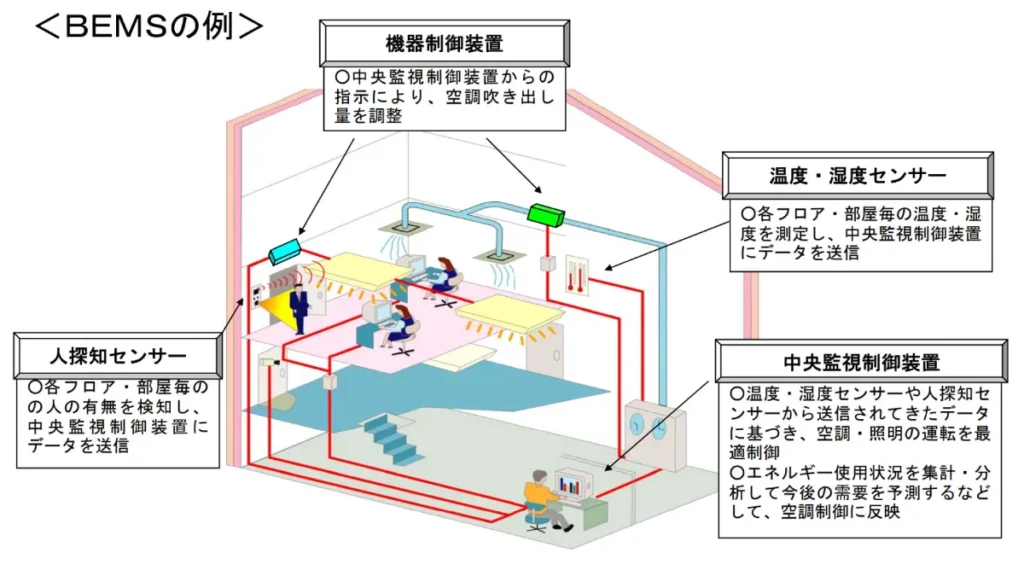
Generally, BEMS consists ofControl section,Monitoring section,Management sectionthree components.
Source: Ministry of the Environment
http://www.env.go.jp/council/06earth/y060-81/mat02-2.pdf
The control section refers to the parts with temperature • humidity sensors, human detection sensors, watt-hour meters, gas meters, and other measuring instruments, which measure the usage status and energy consumption of equipment and transmit data to the monitoring section. In the example diagram above, temperature • humidity sensors measure temperature • humidity for each floor • room, human detection sensors detect the presence of people, and each transmits data to the central monitoring and control device.80
In the monitoring section, based on data transmitted to the central monitoring and control device, operations such as air conditioning and lighting are optimally controlled. It is also possible to aggregate • analyze energy usage status, forecast future demand, and reflect it in control. Additionally, according to instructions from the central monitoring and control device, the equipment control device controls air conditioning operations.80
In the management section, maintenance and cleaning of air conditioning, lighting equipment, etc. are performed.80
Benefits of Implementing BEMS
When BEMS is implemented in a building, energy (mainly electricity) usage status becomes " visualized ", allowing optimal control of air conditioning and lighting equipment operations based on it. This control reduces power consumption and peak power, resulting in energy • cost savings.
" Visualization " of Energy Usage Status
BEMS enables you to know when, in which area • facility, and how energy is being consumed. In other words, " visualization " of usage status is realized. Since locations and time periods where energy is being wasted can be identified, it becomes easier to develop improvement plans.
A major benefit is that data can be displayed in an easy-to-understand format, such as graphs. When the entire company works on energy conservation, not just management personnel, it helps share energy usage status with general employees as well.
Energy Savings Without Sacrifice
" Visualization " of energy usage status clarifies the path to improvement and realizes efficient energy savings. For example, while lighting and air conditioning were previously operated uniformly, BEMS can control operations in locations and time periods with fewer people, reducing energy consumption.
Furthermore, with BEMS automatic control, the key point is that necessary operations are maintained. With conventional uniform energy-saving and power-saving measures, rooms became dark or could not flexibly respond to heat and cold, ultimately reducing work efficiency. With BEMS-controlled operations, necessary operations are automatically identified, enabling energy savings without reducing work efficiency.
Lower Electricity Bills
To reduce commercial electricity rates, it is highly effective to first reduce power consumption and then lower the basic rate. To lower the basic rate, it is necessary to reduce contracted power, and BEMS functions are useful for this.
Contracted power is determined by the power at the time of highest usage in the past year, and that contracted power continues for one year. Therefore, the key is how to suppress this peak power. By eliminating wasteful usage with BEMS and taking measures to suppress peak power based on " visualized " usage status, it becomes possible to reduce contracted power.
Understanding Equipment Deterioration Status
Since data on energy usage status is automatically accumulated, it becomes easier to understand the deterioration status of equipment, such as decreased energy efficiency, at an early stage, leading to maintenance at appropriate timing.
Summary
As an essential system for energy conservation and CO2 emission reduction, BEMS is expected to be increasingly implemented in the future. Although implementation costs are involved, national and local governments are providing support through various subsidies and support systems. It appears that even small and medium-sized buildings are at the stage of considering BEMS implementation.