

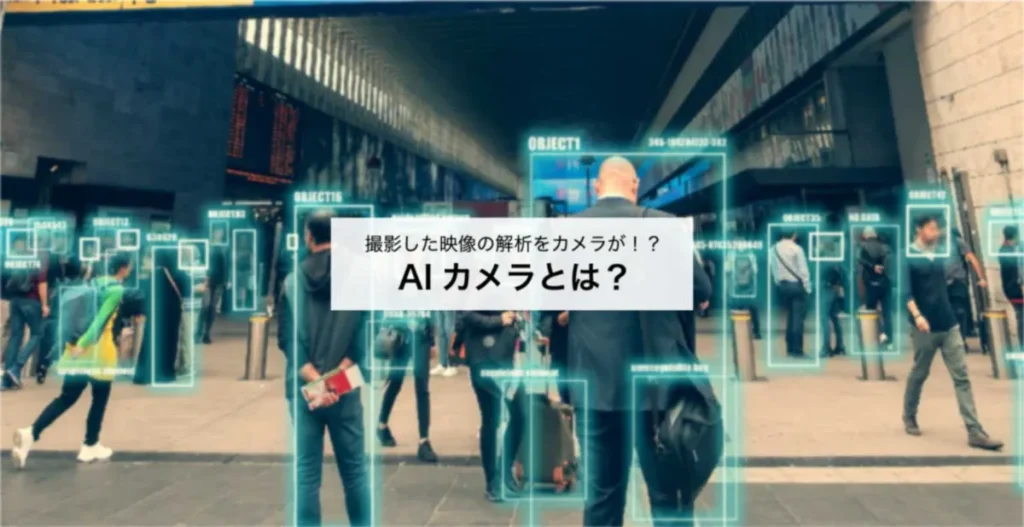
The adoption of AI cameras incorporating artificial intelligence (AI) is advancing. AI cameras are already seen in various locations such as stores, offices, and factories, but let's review the basics of what kind of device they are and what applications they have. We will also introduce the latest use cases.
What is an AI Camera
AI cameras are equipped with AI, as the suggests. With conventional cameras, humans view the captured footage, but with AI cameras, AI reviews and analyzes the footage. In other words, an AI camera can be described as a camera with the function to analyze captured footage.
The shooting functions of AI cameras are basically the same as conventional cameras. They are equipped with autofocus through face recognition, exposure adjustment functions, and functions that track human movement, with performance improving year by year.
Regarding analysis functions, as we will also introduce in the later section What AI Cameras Can Do , there are functions that classify captured footage to determine attributes and functions that detect matches with pre-registered data. A major point is that both types not only eliminate the need for manual labor in analysis work through AI integration, but also expand applications and convenience.
Types of AI Cameras
There are two types of AI cameras depending on where AI processing is performed: edge type, which processes at edge devices, and cloud type, which processes in the cloud.
Edge AI Cameras
Edge AI is a technology that performs information processing by directly installing AI in edge devices such as IoT devices, sensors, and cameras. Therefore, an edge AI camera is a camera equipped with AI.
Edge AI cameras have strengths in real-time processing, and captured footage is analyzed immediately. Since internet communication is not required between shooting and analysis, this saves communication costs and offers security advantages. When storing data, only necessary data is sent to and stored on the server.
Cloud AI Cameras
Cloud AI is a technology that processes information by sending data to a cloud equipped with AI. The AI is installed in a cloud server located away from the camera, and all footage captured by the camera is sent to the cloud, where the AI performs analysis.
It should be noted that since all data needs to be sent to the cloud, the communication volume becomes enormous, making it susceptible to communication environment conditions and posing security risks.
What AI Cameras Can Do
The things AI cameras can analyze are diverse. We will introduce them broadly classified into four categories.
Human Detection
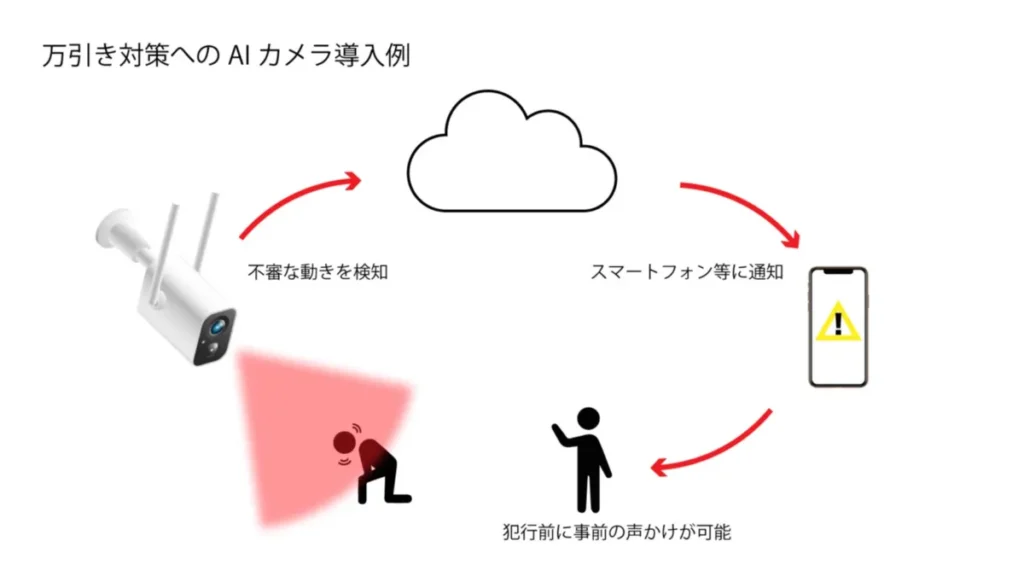
Detects the entire body of people captured by the camera. In specific areas, it can count thenumber of peopleand measuredwell time, making it possible to graspcongestion status. In addition to potential applications in marketing,suspicious movementsandintrusion detectioninto prohibited areas are also possible, making it promising for security use.
Object Detection
Detects pre-specified objects. It counts thenumber of vehicles, and in manufacturing, it is also utilized forvisual inspection foreign object detection. Additionally, since it can count thenumber of cardboard boxes, it is effective for checking product inventory status and managing loading/unloading in distribution warehouses and stores.
At construction sites, it detects whetherhelmets are worn, and at railway stations,white canes and wheelchairsare detected at ticket gates to notify staff in real-time, with demonstration experiments already underway.
Face Recognition Face Authentication
This technology recognizes the faces of people captured by the camera and can estimategenderandage. Since it can also determine whether a person matches pre-registered individuals, it can be used as a face authentication system for office entry/exit management and attendance management. Efforts to estimate humanemotionsfrom facial expressions have also begun.
Character Recognition
Recognizes characters such as vehiclelicense platesand destinationswritten on shipping tags. Recognition of vehicle license plates enables vehicle authentication at parking lots and other locations. Furthermore, as something similar to characters,barcodescan also be detected.
AI Camera Use Cases
AI cameras are currently being widely utilized. Let's look at the latest use cases.
Retail Store Sales Floor Design
When AI cameras are introduced in retail stores, customer attributes and behavior are visualized and can be utilized for creating sales-driving store layouts. Information that can be collected by AI cameras includes gender age group in-store traffic flow dwell time, and more. Knowing the gender and age group of purchasers enables understanding which products are preferred by which customer attributes, which can be applied to product procurement. Information on customer traffic flow and dwell time becomes material for considering store layout, product placement, and selection of products to sell.
Unmanned Stores
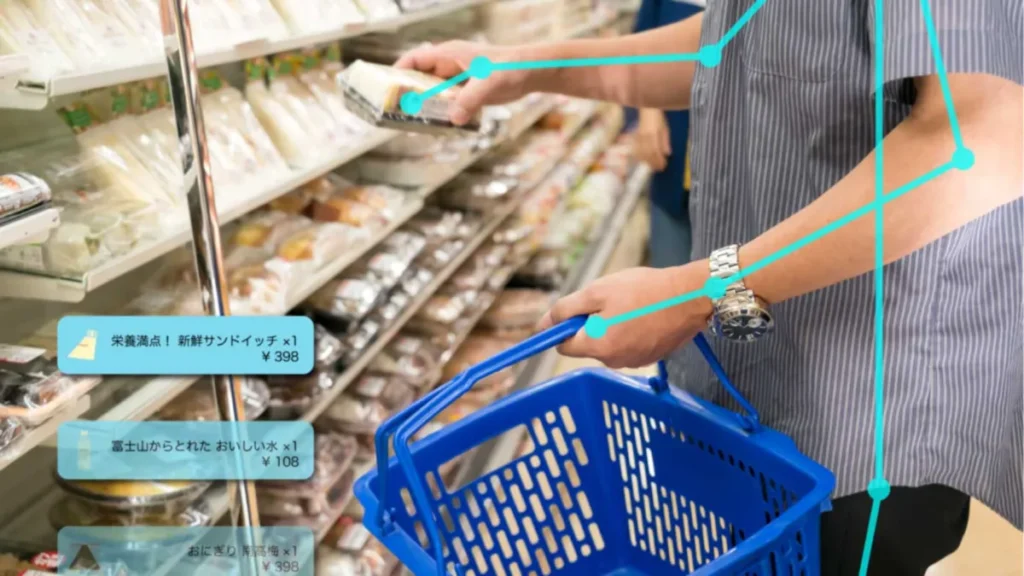
Unmanned stores using AI and sensor technology have also begun to be deployed in Japan. Multiple cameras installed in the store track shoppers and recognize which products on the shelves they pick up. Accuracy has improved to a level where precise recognition is possible even in crowded conditions.
Optimization of In-Store Digital Signage
By using AI cameras, advertising delivery on digital signage installed in retail stores can be optimized. Unlike conventional advertising delivery that continuously loops, when an AI camera detects a customer, it plays the advertisement from the beginning at the timing when they pass in front of the product shelf.
Air Conditioning Lighting Optimization
In buildings and factories, AI cameras and sensors are useful for energy management within buildings. Optimization is achieved through systems that finely control lighting and air conditioning through human detection. Even in private residences, AI integration has begun to create living spaces tailored to individual preferences.
Summary
By utilizing AI cameras, vast amounts of video data are transformed into data that can be used for various purposes. In addition to the use cases introduced this time, utilization is already advancing in a wide range of fields such as offices, warehouses, medical care welfare, likely because attention is being paid to the value of data. AI camera adoption will undoubtedly continue to advance further, both for achieving operational efficiency and for advanced marketing.