

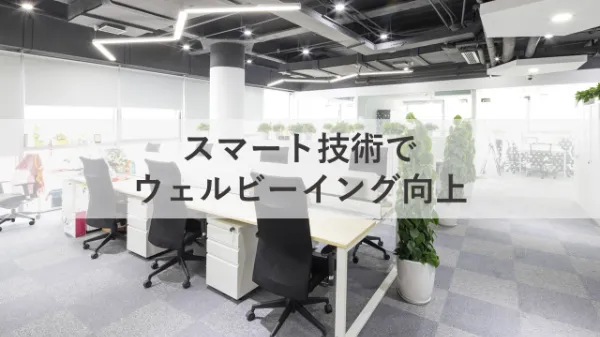
Recently, there has been a notable movement toward office spaces that prioritize the health and well-being of workers. Many companies are beginning initiatives using the international certification system "WELL Certification" as a benchmark. Here, we introduce smart technologies that help improve well-being in offices, as well as buildings that have actually obtained WELL certification.
Reference:What is WELL Certification? Introducing New Standards for Office Spaces
Smart Technologies That Help Improve Office Well-being
Well-being is a concept that means being physically, •mentally, •and socially healthy and fulfilled. Improving well-being in offices means aiming for an environment where workers can work in good physical and mental health and with social satisfaction.
In recent years, smart technologies including IoT and AI are expected as solutions for this purpose. Let's look at smart technologies that are effective in improving office well-being and useful for WELL certification, following the evaluation items (*) of WELL v2, the latest version of WELL certification.
*The evaluation items of WELL v2 consist of 10 concepts: "Air," "Water," "Nourishment," "Light," "Movement," "Thermal Comfort," "Sound," "Materials," "Mind," "Community," and "Innovation."
Advanced Control of "Air" Quality
Among office environments, air quality has been particularly emphasized in recent years. Air quality involves temperature, humidity, carbon dioxide (CO2), PM2.5, and other factors, and it has been found that when these conditions deteriorate, they affect not only work productivity but also health.
Improving air quality requires proper ventilation. The first step is visualizing air quality by continuously monitoring data such as CO2 concentration and PM2.5 in the air using various IoT sensors to understand air conditions. Linked to this, ventilation systems operate to automatically ventilate at appropriate times.
It is also possible to utilize occupancy density data for ventilation control, with sensing technologies such as sensors and spatial scanners being utilized. Flexible ventilation systems that automatically ventilate according to increases and decreases in occupancy while monitoring air quality have also been realized.
Reference:Air Supporting Office Well-being: The Key is CO2 Concentration Control

Enhancing "Thermal Comfort" Through Temperature •and Humidity Management
Systems that detect office temperature •and humidity with sensors and automatically control air conditioning equipment according to conditions enhance worker comfort. Going further, individual air conditioning control aimed at improving comfort on a personal level is also becoming possible.
Air conditioning equipment is also evolving in diverse ways, with examples adopting underfloor air distribution and radiant cooling with thermal mass.
Regulating Body Rhythms by Changing the Amount and Color of "Light"
Living organisms, including humans, have an approximately 24-hour rhythm called "circadian rhythm." Prolonged disruption of this rhythm can adversely affect health. While maintaining a regular lifestyle is fundamental to keeping this rhythm normal, it has been found that light plays a major role—bathing in morning sunlight and reducing light at night.
While it is difficult to receive sufficient natural light in office spaces, adjusting the amount of light (brightness) and light color (color temperature) with LED lighting has made it possible to create lighting that approximates natural light. Lighting that can adjust brightness and color temperature according to time of day to match biological rhythms is called "circadian lighting," and its introduction into offices is progressing. Systems that combine image sensors to simultaneously control human movement and brightness have also been developed, achieving both comfort and energy savings.
Sound Masking That Makes "Sound" Less Noticeable
"Sound masking" is a system that prevents sound and conversation from leaking by deliberately playing other sounds in spaces where sound is generated, such as conference rooms. It works by canceling sound with sound, and commonly uses environmental sounds like air conditioning noise or the murmur of a stream. Sound masking has the effect of making highly confidential conversations less audible to surroundings. Conversely, it also has the benefit of making it easier for people working nearby to concentrate on their own tasks.
For smart workplaces with layouts where personal and shared spaces are adjacent, systems have been developed that link with individual location information to emit masking sounds only where and when needed.
Buildings That Have Obtained WELL Certification
As representatives of office spaces that prioritize well-being, we introduce buildings that have obtained WELL certification. WELL certification has four levels: Bronze, Silver, Gold, and Platinum, and many companies in Japan are already working toward and achieving Gold and Platinum.
Coworking Space "point 0 marunouchi"
Obtained WELL v2 Gold certification in December 2020. As the first coworking space in Japan to obtain certification, it incorporates various innovations such as zoned air conditioning that realizes multiple temperature environments and circadian lighting. This office space was realized through collaboration among major companies centered on Daikin, Panasonic, and Okamura, and is also attracting attention as a site for demonstration experiments toward future ideals.
Panasonic •System Solution Development Center
Obtained WELL v2 Gold certification in January 2021. Systems that enhance air quality (total heat exchange ventilation system, air quality monitor, spatial sterilization and deodorization equipment, etc.) and circadian lighting have been adopted.
Iris Group Tokyo Antenna Office
Obtained Platinum certification in September 2022. The office enhances comfort primarily using its own products, including circadian lighting and autonomous AI sterilization and cleaning robots.
Obayashi Corporation Training Facility "Port Plus"
Obtained Platinum certification in February 2023. Achieved comprehensively high scores through circadian lighting and advanced IoT air conditioning control using camera images.
Nikken Sekkei Tokyo Building
Obtained Platinum certification in August 2022 for the 7th floor renovation of Nikken Sekkei Tokyo Building. Equipped with circadian lighting, sound masking system, motorized exterior blind system, and more. Demonstrated that certification can be obtained for existing buildings through renovation.
In addition, Takenaka Corporation Tokyo Head Office and Shimizu Corporation Tohoku Branch new building have obtained certification.
Summary
Initiatives aimed at improving the well-being of office workers will continue to expand with the support of the WELL certification system and other factors. Among various solutions, the use of smart technologies is particularly effective and undoubtedly essential. We should pay attention to smart technologies that continue to evolve daily and actively incorporate them into office environment improvements.