


A new learning style utilizing IT, "e-learning". Triggered by the difficulty of conducting in-person learning and training as before due to the COVID-19 pandemic, adoption has been advancing in various fields in recent years. Here, we review the overview of e-learning and explain the latest trends.
What is E-Learning
E-learning refers to a method of learning and training through the internet using devices such as PCs, tablets, and smartphones. Unlike traditional learning styles where people gather in a specific location to attend lectures, it offers many advantages such as the ability to learn regardless of time and place, and its adoption is expanding in individual •school•cram school learning and organizational training.
The main features of e-learning are as follows. It can be said to be a learning style with advantages for both learners and administrators.
- Less restricted by time and location
- Uniform teaching quality can be achieved
- Optimized learning can be provided according to each learner's situation and level
- Easy management of learner progress
While implementing e-learning involves costs and challenges such as difficulty in motivating learners, its advantages greatly outweighed these during the pandemic, leading to increased demand.
Structure of E-Learning
E-learning mainly consists of a "learning management system" and "educational content".
Learning Management System
A learning management system is the foundational system for implementing e-learning, providing learners with a learning environment while integrating and managing the distribution of learning materials, attendance records, grades, and more. It can handle large-scale learners and materials. It is also called LMS (abbreviation for Learning Management System).
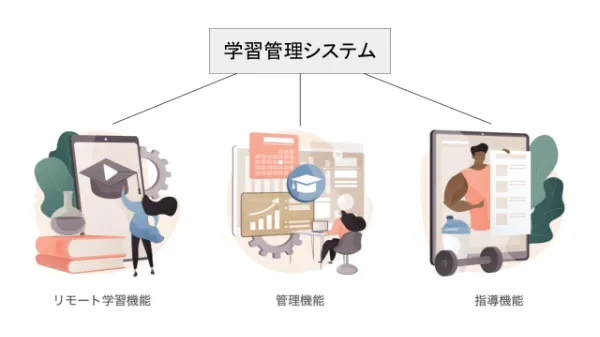
Learning management systems generally have the following functions.
Learner-side Functions
In addition to basic functions such as login and accessing educational content, there are functions for displaying learning progress and test results, submitting tests and reports, and asking questions. Both input and output are possible, and depending on the system, interactive exchanges are available.
Management Functions
Functions for managing all information related to learners, including registration •attendance•progress•grades, etc. This allows confirmation of "which materials learners studied and how their grades were". Management of materials and courses is also possible.
Instructional Functions
In addition to functions for confirming and responding to questions from learners, individual instruction is possible as learning progress, report collection status, and grades can be confirmed for each learner.
When implementing e-learning, introducing a learning management system that can centrally manage learner attendance and learning status is efficient and effective. In line with the growing demand for e-learning, many services providing learning management systems have emerged. Selecting a service that fits each organization seems to be the key to e-learning success.
Educational Content
In e-learning, the following types of educational content can be used.
- Video materials recording classes and lectures
- Live classes streaming classes and lectures in real-time
- Slideshow-type materials (created with PowerPoint, Word, etc.)
- Drill-type materials (test question format)
- Hybrid materials
Educational content was initially centered on text materials when e-learning began, but as the internet became broadband and high-speed •large-capacity data communication became possible, video materials have become mainstream. Various formats of content centered on video materials are being created, such as those directly recording classroom classes •lectures with cameras and those combining PowerPoint with video.
Methods for preparing educational content include purchasing ready-made products, customization, custom-ordering original content, and the option of creating everything in-house. For general content such as PC operations, languages, and business knowledge, ready-made package products are convenient and reliable in terms of quality, but there is active movement toward preparing content through customization, custom-ordering, and even in-house creation to seek content that better fits objectives.
For creating materials in-house, it is common to use learning management systems equipped with material creation functions or editing •creation software called authoring tools. While it places a burden on the organization, there is the advantage of being able to aim for higher educational effectiveness because staff who are well-versed in educational objectives and content create •supervise the materials.
Latest E-Learning Trends
With the remarkable spread of smartphones and tablets in recent years, the following changes in e-learning have become noticeable due to this influence.
Multi-device Support
While e-learning in the past assumed PC use, in recent years, learning on smartphones and tablets has become preferred, so support for multi-devices is advancing. As for materials, video materials tend to be chosen because they are easy to play on various devices.
Increase in Practical E-Learning
Practical e-learning that teaches operation methods and work procedures using video and visual materials is increasing. Mainly e-learning targeting people working in fields such as service, manufacturing, and healthcare Sites, it uses Sites know-how converted into visual materials. Traditionally, e-learning learners were mainly desk workers, but the realization of practical e-learning has expanded the target audience.
Shorter Duration with Microlearning
Microlearning is a learning style conducted in short periods of about 1-5 minutes. For e-learning conducted using smartphones, microlearning is more suitable than learning a large amount at once, and it has gained attention. Because learning time is easy to manage, high-frequency learning can be expected even in short periods.
Summary
While e-learning has been steadily growing in demand year by year, its advantages were highlighted due to the COVID-19 pandemic, and it now seems to have established itself as a major learning style. Many services providing systems and content have also become available. When implementing e-learning, it is important to understand the features and mechanisms of e-learning and adopt it wisely.