

" Data exists but cannot be utilized " Sites What is happening at
As DX initiatives expand, Sites has been making progress in acquiring various data • visualization. Environments where previously difficult-to-grasp information such as equipment utilization rates and energy consumption can be checked in real time are also increasing. On the other hand, voices are also heard saying " data is being collected but not leading to improvements " and " dashboards have increased, but Sites behavior has not changed. " This time, we will organize the issues actually occurring at Sites where data utilization is difficult to advance.
Issue 1: Only dashboards keep increasing
As a first step in promoting DX, " visualization " is progressing at many Sites. Equipment operating status, temperature • humidity, energy consumption, defect rates, etc. can now be checked on screen, making it easier to grasp the situation than before.
However, there are many cases where dashboards exist but are not connected to daily decisions or improvements. Even if graphs are displayed on large monitors and data is updated daily, if response rules and judgment criteria when abnormal values are displayed are not established, it ends up being " just viewing ".
Also, situations are seen where dashboards increase each time a new system is introduced, and personnel must compare multiple screens. Important notifications get buried as alerts are frequently displayed, and gradually no one checks them anymore—in such a state, even carefully acquired data is not fully utilized.
Originally, " visualization " is not a goal but a starting point. What is important is operational design of how to connect displayed information to decisions and improvements.

Issue 2: Data is being collected but not used for decision-making
Behind the lack of progress in data utilization is that utilization policies are not sufficiently organized. For example, even when acquiring production equipment operation data,
• What do we want to improve?
• Which indicators should be prioritized?
• Who will make decisions?
If these are not organized, data tends to just accumulate.
Even in meetings, conventional rules of thumb and intuition are prioritized, and data remains as reference material. As a result, " collecting " becomes the purpose, creating a situation that does not lead to actual improvement actions.
Of course, Sites intuition and experience are important. However, as equipment and energy operations become more complex, changes that cannot be fully grasped by experience alone are also increasing. To respond appropriately to such changes, what is required is not " collecting " data, but " making it usable for decisions. "
Issue 3: Data is fragmented by department
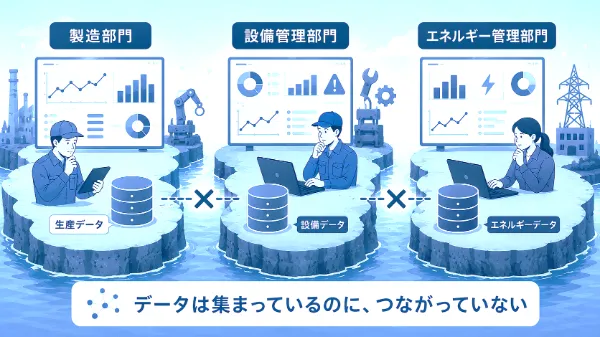
Another major issue is that data is fragmented between departments. For example, cases where the manufacturing department manages production data, the equipment management department manages maintenance data, and the general affairs department manages energy consumption, each separately.
When data is managed individually like this, it becomes difficult to analyze the relationship between equipment operation and energy consumption cross-functionally, and it also becomes difficult to connect to overall optimization. Furthermore, when data formats and update timing differ by system, the effort to integrate necessary information increases, raising the hurdle for utilization.
For example, there are situations where manufacturing Sites wants to analyze the causes of equipment stoppages, but equipment data is in a separate system, energy data is on a different management screen, and maintenance history is managed in Excel. Each time, personnel need to collect and process data, taking time before analysis.
In other words, it is a state where " data is collected but not connected. " Even if the amount of data increases, if it cannot be linked, it becomes difficult to connect to Sites improvements.
What is needed is a " mechanism for utilization "
To solve these issues, it is important not just to collect data, but to build a mechanism for utilization.
Acquired data,
• Share at Sites
• Assess the situation
• Connect to operational improvements
• Reflect in control as needed
Only when this flow is established does data have value.
In recent years, the importance of IoT platforms that can integrate various sensors and equipment data for unified visualization • management is also increasing. Creating an environment where operations can be conducted while linking multiple data is becoming key to promoting DX.
As DX progresses, the environment for acquiring data itself has been rapidly improving. What is now required is not the perspective of " how much data was collected ", but " how to utilize it and connect it to Sites improvements. "
Also, data utilization will not continue if it depends only on specific personnel. It is important to establish it as a mechanism where Sites, management departments, and executive leadership share common indicators and can utilize them from their respective positions.
Summary
Through the promotion of DX, environments where data can be acquired • visualized at many Sites have been improving. However, if it ends with just increasing dashboards or data is fragmented by department, it becomes easy to stumble at the utilization stage. What is important is not collecting data, but operating it in a form that connects to Sites decisions and improvements. From data acquisition to visualization, analysis, and then control. Establishing this flow at Sites is what is required for DX going forward.